Showing posts with label medical ethics. Show all posts

Sunday, January 22, 2012

A Patient with Natural Supplements 3

In the last couple of posts, I recounted having to spend about 2 hours looking up all of the ingredients of all of the supplements a patient of mine was taking, at the prescription of her chiropractor.

This post is about my anger.

Why aren’t supplement ingredients on the label of the product?

How come most prescription products come with a sheet of paper the size of a tablecloth, folded 1024 times so it ends up the size of a stamp, completely covered with tiny print that is required bylaw to mention every rare adverse event that happened to subjects during a clinical trial?  Because it’s required.

If the product is effective as a drug, and is used as a drug, why aren’t there clinical trials? 

Why do I need to spend 2 hours looking this stuff up?

Why didn’t the other guy review with the patient all the potential side effects, the risks of interactions, the risks of hypotension and collapse, of bleeding spontaneously, of increased menstrual cramps, flushing, lactating, breast pain, odd body odor, stomach pain, gas pain, diarrhea, allergic reactions, rashes, itches?

Why is it that I have to reassure myself that the undocumented sourcing of slaughterhouse discards of adrenal and thymus glands and testicles from many animals of several species won’t require disclosure of the risk of Bovine Spongiform Encephalopathy—Mad Cow Disease?

Why should I have to worry about the products claiming to be better and natural sources of vitamins because they are derived from algae?  The fact that algae are being proposed to de-contaminate toxic heavy-metal superfund sites, because they so selectively accumulate this kind of poison, shouldn’t be a problem for people taking algae every day, right? 

If I prescribe a medication, and there’s a problem interaction with one of the supplements, who will rush to help the patient?  Who will answer the phone on the weekend, or at night?  Who will spend the time to figure it out?  Who will be blamed?

And it did, indeed, occur to me after hours of research into these products and their ingredients, that I looked up what was on the label.  There is no regulation requiring that what is on the label is exactly what is in the pill, or if it’s fresh, or if it’s not contaminated, infected, or accurate. 

Are you really, really sure you want your kids taking this stuff?  Is it really better than whatever you consider a drug?  Did the person at the health food store tell you about all the side effects and interactions?  Did that nice woman in your mom’s group?

Monday, January 9, 2012

A Patient with Natural Supplements 1

Late last week, I met a new patient.  A delightful teenager, she was interesting and engaging.  She was insightful and open, and I agreed with part of the diagnosis she came in with.  I would be prescribing some medication for her.

I asked some typical new-prescription questions.  Was she taking any medications?  Did she have any allergies?  No, and no.

It was the first time I met her, so I asked about her stuffy nose that she kept rubbing.  Well, she did have those kind of allergies.  As we went through some of her medical issues, she revealed some typical teenage-girl symptoms.  I asked if she has tried to do anything about these, does she take ibuprofen, and so on.  She said that her mom took her to the chiropractor, and she takes some supplements that were recommended.

Which supplement?  She didn’t know.  She said it was 8. 

“Eight ingredients?” I asked.

“No,” she said.  “Eight separate bottles.”

“What do they do?”

“I don’t know,” she said, earnestly.  At my request, a parent emailed me the list.

Don’t expect a complete horror story—this isn’t one.  Most of the products were basically vitamins.  Calcium from seashells, and B-vitamins from Blue-green algae.  There were a couple of surprises, and some insight from my research.

Funny thing about algae:  it concentrates what is in the water it lives in.  So it is a concentrated form of protein and vitamins.  But it is often found with high levels of heavy metals.  And sometimes it gets contaminated with microorganisms you probably don’t want.

There were a number of products with names that didn’t give a clue about what they were for.  So I looked up the manufacturers, got their list of products, then found the ingredients. 

As an aside, I have to imagine that the target market for many of these products has its bulls-eye right here in Berkeley, where the vegans look upon vegetarians as insincere poseurs, ersatz Dr. Strangelove apologists for global thermonuclear annihilation.

So imagine my amusement and the gleeful profundity of my schadenfreude when I found that the product called Okra Pepsin (sounds vegetable-y, right?) contains what the manufacturer claims to be a ‘proprietary blend’ (they don’t need to worry about me stealing the secret formula) containing bovine orchic extract.  Perhaps they use an extract of orchids that look like cows.

Not exactly.  The go to slaughterhouses, ask if there are some testicles lying around, and then, you know, extract.

Why did this teenage girl need this?  I couldn’t guess.  She was also taking products using ground thymus glans from slaughtered animals including cows and sheep and maybe other species.  And another product with adrenal glands.

Hey, in some places they consider organ meats a delicacy.

Friday, August 6, 2010

Mystery Diagnosis—the Doctor’s Role

More than a year ago, I wrote about a little-known entity that I have sometimes diagnosed in a mother who is complaining about wrist pain.  Called Nursemaid’s Wrist, it is hard to find online or even in many medical textbooks.  It has nothing whatever to do with Nursemaid’s Elbow, which is something that kids can get.  Nursemaid’s Wrist is a pain in the wrist that adults, usually mothers or those who care for infants, get from repetitively stooping to pick up a baby.

It’s easy, of course, to underestimate the weight of a baby.  The average birth weight these days is over 7 pounds, and by the time the baby is 4 months old, it might be double that.  If the baby were a bowling ball—professional bowler weight—it would seem quite heavy.  A 4-month-old weighs about the same as a 2-gallon container of water.  It’s easy to see how someone lifting and moving that kind of weight can get sore.  But they are moving that object with considerably more care than they might a plastic jug of water or a bowling ball.  The muscle tension required for fine movement control while holding on to a heavy weight puts an enormous strain on the whole mechanical system.  Some muscles of the body seem well designed to handle massive enlargement and strengthening if circumstances required it.  Biceps and shoulders, and the muscles of running and leg movement are good examples.  Except for a protective covering of skin, they have a good blood supply and can pretty much expand from exercise to whatever size is needed.  Though we’ve all seen photos of shockingly-massive bodybuilders, much of the muscle size they have is in these muscle groups.  The fact that babies are considerably more adorable than, for example, steel weights, gives us the motivation to keep picking them up.  Weightlifters, however, are not looking to build up or enlarge those fine-motor muscles, which are usually invisible even in the most defined physique.

The wrist problem occurs because those fine-control muscles, of the hand and fingers and forearm, are threaded though a remarkable system of lubricated sheaths to keep everything operating smoothly.  They are threaded through notches to keep them from tangling or getting caught on angles of our bones and joints, and they slip through guide-channels so that they don’t restrict the range of motion of our joints.  With enough repeated exercise, just like lifting a barbell, those little muscles get stronger—and bigger.  If they get even a little too big, they start rubbing the inside of the sheath they pass through, they rub against each other, and they don’t slide as easily through their notches.  This leads to irritation, inflammation, and pain.  Carpal Tunnel Syndrome is the best known of these, but there are others.  Treatment is simple, if inconvenient with a baby around.  Immobilize the problem area, ice if possible, and anti-inflammatory medicine like ibuprofen.

This leads to the important question of this post.  The same question has come up before and probably will again.  What, exactly , is my job?

I’ve worked in other practices where the pediatrician’s job is reasonably clear.  Since I was paid a fixed salary and the practice was paid a fixed price per visit, there was constant pressure from management or the owner/partners to do as many visits as possible.  There was never any kind of incentive, even appreciation, for doing a good job, being thorough, ending a visit without the child screaming and traumatized.

When I started my own practice, I wanted to do things differently.  I knew, of course, that the business model of the factory-production design of medical-care delivery was the way a doctor could earn a living.  There are some really good reasons that nobody else practices the way I do.  Still, I wanted to have the feeling of taking care of kids and dealing with the whole person.

That sounds great, but it is so different from my training and experience that some really confusing issues have come up.  In the 8-minute pediatric visit, the doctor has decided that your kid’s upset stomach is from a virus and not appendicitis, tells you to keep up with fluids, and has left.  That, to be blunt, is the standard of care.  Teasing out the history of stomach aches, the recent weight loss, and a recent history of food refusal could take an hour, especially if the doctor actually tries to ask the child.  And what about symptoms in the parents?  These could hold an important clue to what could be going on in a child.

Where does my care of the child end and care for the parent begin?  All of my insight about postpartum depression stems from my belief that it’s not all about the mother.  It’s the mother-baby system that somehow isn’t working optimally.  Helping the mother is de facto helping the baby, who is indeed my patient.  In the same way, I would strongly urge any parent to wear a bicycle helmet.  My patient needs you.  Without a head injury.

Which leads to the case at hand.  A mother, mid-30’s, was in today with her baby.  The baby was fine, but mother was wearing black neoprene wrist supports.  I asked what was going on.  She said that she had been having wrist pain and went to her doctor, who told her she had carpal tunnel syndrome.  Here’s where my role gets confusing.  What could she be doing that could give her carpal tunnel syndrome in both wrists at the same time?  I didn’t think she was working in a parts-assembly factory or on a computer since the baby was born 3 weeks ago.  She wasn’t, she confirmed, and after asking her a few more questions, it was clear that this wasn’t carpal tunnel.  Do I tell her her doctor was wrong? 
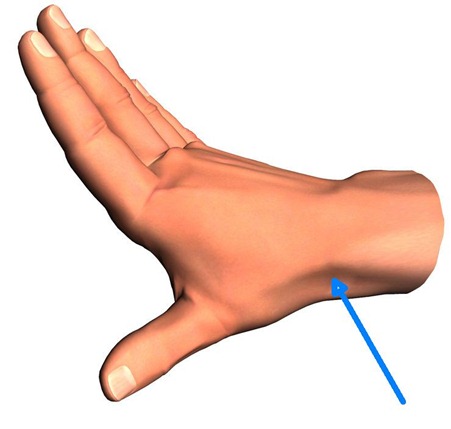
hand with arrow1
She pointed to where it hurt, which was the same on both left and right.  Uh, that’s not where carpal tunnel hurts.  It wasn’t where nursemaid’s wrist hurts, either, and that was what I had been thinking.  I touched where she said it hurt, and she confirmed a little bit of pain.  I asked her to hold her hand bent in a certain way, then I pressed her thumb across her palm.  This hurt a little, too.  In this position, I pressed on the spot pointed out by the arrow in the picture above.  She jumped.  This was the Finkelstein Test—I’m not making that up.  I know, it sounds like an algebra mid-term from high school.  (He published this in the late 19th-century, I think.)  Her reaction led me to her diagnosis.

DeQuervain’s Tenosynovitis isn’t something that people assume they have.  It occurs mostly in women, mostly in their 30’s and 40’s.  It is thought that long before Dr. DeQuervain stuck his name to it more than 100 years ago, it was known as mother’s wrist.

If a little knowledge is a dangerous thing, what about knowing about the Finkelstein Test?  I suppose it would be right to say I couldn’t be positive about her diagnosis, but I was pretty sure this is what she had. 

Here are some of the issues for me as a physician:
  1. I’m not a doctor for grown-ups.  Do I mind my own business even if I think I’ve got a clue—and maybe they don’t? 
  2. Do I say something cautious like, ‘Maybe you should get another opinion.’  Isn’t my opinion another opinion?
  3. If I say, ‘Have you looked into DeQuervain’s Tenosynovitis?  It’s going around,’ what is the message I’m really sending?
  4. If I say, ‘I believe you have DeQuervain’s Tenosynovitis,’ what is my next obligation?  Do I have to treat it or suggest treatment?
  5. What if I’m wrong?
  6. How much work do I have to do, especially since I can’t get paid for any of it?  Officially, the mother is not my patient.
  7. Since I was bold enough to bring up the fact that I can’t get paid anything for diagnosing or treating the mother, it’s obvious that this fact doesn’t reduce my potential liability.
So here, too, is a problem with medical specialization.  I presume that if the crippling pain were bad enough, this woman’s repeated visits to her primary care physician would eventually have led her to an orthopedic surgeon.  Hopefully they have already paid for their college-age child’s BMW (not that I’m cynical about it), and will not simply advise the woman to have hand surgery when a splint and some Advil is all she might need.  In the meantime, my patient—a sweet baby who needs to be held and nursed and changed and loved by his mother—will suffer. 

Let me go one step further.  If I know the diagnosis, if I can help this woman’s suffering, don’t I have some sort of obligation to help?  Am I required to look the other way because of my contract with her health-insurer?  In this case, of course, there isn’t anything life-threatening that would meet the criteria of what any reasonable person would do.   This comes up, for example, when somebody is obviously gravely hurt and anybody—not just a doctor—would call for help. 

Do you think I’ll leave it at that?  I didn’t think so.  This case is a proxy for treating even my own patients for mental health problems.  Though child mental health care (and to a lesser extent adult mental health, as well), is usually either completely unavailable or nearly unavailable; though it is unaffordable if available; and though access to it is severely limited by health insurance, physicians are generally precluded from providing this care.  So even though I’m willing to do it, I do a good job—especially with certain problems, I’m available and I’m willing to take about 20-30% of what they would usually have to pay, insurance companies will not pay me to diagnose and treat most mental-health problems.  Some won’t even let me prescribe the appropriate medications.  (I can prescribe them, but they won’t pay for them.)

And it’s a proxy for the inadequate recognition and treatment of postpartum depression.  This is seen by me, diagnosed by me, treated by me.  I get paid nothing for this, yet there’s no one to whom I can refer these women.  I’m lucky that one of the authorities in the field is nearby and will take referrals—without taking insurance.  After her, however, it’s me.

Just because I make no secret of believing I should be paid for my work doesn’t mean I won’t do what’s required of me.  By me.  So I had to create my own practice where the family of the baby got what it needed for the benefit of the baby.  That, in the big picture, is Holistic Medicine.

I found some information on DeQuervain’s Tenosynovitis on the internet and printed it out for her.  Treatment required a completely different kind of splint, which I also described.  I don’t know the name of her doctor and didn’t ask who it was.  But I deeply suspect that there were only a couple of reasons that she was still suffering in pain.  Either the doctor didn’t know about this unusual diagnosis, or didn’t listen carefully enough to the patient.  It was in her description of the the problem, the timing of its onset, and the exact location of the pain that eliminated diagnostic possibilities like carpal tunnel syndrome.  I think these are both potential problems:  a doctor who doesn’t know or a doctor who doesn’t listen.  Nobody can know everything, and this is an unrealistic goal.  But it would be great if doctors would spend the time to listen carefully, and then be open about not knowing.  When that happens, good doctors hit the books.

As a closing aside, this is an ongoing pattern in Every Patient Tells a Story, a book about unusual diagnoses that I like a lot and reviewed in this blog a while ago.  Though the author was kind about it, the first doctor to see these unusual problems often didn’t make a correct diagnosis.  But at some point, all the patients described finally saw a professional who wouldn’t give up, even if they didn’t know.  They reasoned it out, did what homework was needed, and got to the diagnosis.  Of course, they weren’t paid more for this extra work than the doctor who said, because it would take the least time, ‘carpal tunnel syndrome.’

Friday, April 16, 2010

Cultural Sensitivity

linkage tree-2

A delightful couple, pregnant with their first child, came to the office to interview me, to help them decide if I was the right pediatrician for their baby. We had a lovely chat and I felt that I was doing well. At the very end, they asked a question. “Do you have many Asian patients? Do you find you have to ask questions a different way with them or that you have to take a different approach?“ I took these questions as an inquiry about my level of cultural sensitivity. I had a long answer. For the record, though, these people looked by their facial features to be of Asian ancestry; the last name appeared to be of Japanese origin.

“It’s the Bay Area, “ I replied. “What are the odds?“ They agreed it was pretty likely that I had some Asian patients. This was the beginning of my reply.

I told them I took care of a group of about 8 or 10 families from Mongolia. They all live near each other because only a couple of them speak any English at all, and the language barrier is substantial. taking care of them has sometimes been a challenge. there are no patient-education materials available in Mongolian. AT&T has available translators via telephone in dozens and dozens of languages, but Mongolian is not among them. I called UNICEF at the United Nations in New York. They did send people to Mongolia, but they had no patient information. Same story when I contacted the World Health Organization in Geneva, Switzerland. At one point I had a polite exchange of emails with the Minister of Health in Ulan Bator, Mongolia. He or the person composing the emails under his direction and signing his name, had good English-Language skills. His office had no written materials on child health in Mongolian. These families are Asian. Am I culturally sensitive with them? Probably not. Since communication is so difficult, we need every extemporaneous sign language technique we can come up with just to convey information.

So cultural sensitivity is not helped by a language barrier. I take care of these Asian patients, but do I take care of them differently? Yes, I suppose so, but it’s not because of a cultural divide.

I’m reminded of a classmate in medical school. When he was 14, his parents and he joined many others on a small boat headed blindly from Vietnam out into the South China Sea. Obviously they made it, and he’s now a fine surgeon. What should I know to deal with his family in a Vietnamese-friendly way? Are Koreans different?

When I was in business, there were no courses that were required, but everyone knew that Japanese investors and businessmen expected certain salesmanship behaviors when they were entertained in New York. In Japan, a completely different set of rules applied. I wasn’t called cultural awareness, it was called good business. In Hong Kong, it was often thought best not to mention that you’d just had a successful series of meetings in Tokyo.

So what was this nice couple asking me? If I had other patients who, by their visible bodily characteristics, appeared to be of Asian descent? Nearly half the human race is of Asian descent. Were they asking if I treated my patients of Japanese descent as if they were Japanese? I don’t know. How many generations have been born in the United States?

I take care of a nice family, for example, with a hyphenated last name. They are all American citizens. They say that they are Brazilian. When their kids were born, I encouraged the parents to speak only Portuguese to them at home. The mother’s ancestors were from Portugal. She looks like a European might. The father’s ancestors were Chinese. He looks Asian. The kids are…adorable. Is this an Asian family? I don’t think even the father’s parents speak much Chinese, back in Brazil. How Asian to you have to be? How Asian to you have to look?

No institution with which I have been associated over the last 20 years or so has failed to offer--actually require, I think--a course of some sort in cultural sensitivity. As demanded, I have wasted valuable hours in these courses. In one, the head of a fabulous Spanish-language health clinic gave a presentation on cultural awareness to the Latino community. Assuming that language wasn’t a barrier, what could I do with that? Ask a proud Ecuadorian if they identify more with Mexicans than with Americans. Ask someone from Spain. Will I learn about the distinctions of all those who speak Spanish in a short course or lecture on cultural sensitivity?
I have a family from Yemen. Devout Muslims, they appreciate that I never extend my hand to the mother. I try to be respectful and to the point. I don’t even close the exam-room door when I see their kids and the father isn’t with them.

I think that doctors--people in general--look fake when they try to be someone they’re not. I also think that doctors can be particularly culturally insensitive. But I think it’s cynical political correctness to require learning cultural sensitivity. What they really need to learn is just sensitivity.

There’s no way that patients will perceive a doctor to be sensitive in a 5-minute visit. The doctor you’ve never met, comes in while reading the chart for the first time, doesn’t know your name, does humiliating things to you, then leaves without hearing your complaints or insights. In which culture is this considered acceptable? What part of the world do you have to be from to feel better after this encounter?

If physicians are going to be culturally sensitive, they must first spend enough time with the patient to listen. Maybe they can take a course on reading body language and eye contact, tone of voice or listening skills. Maybe they can learn to interrupt just a little bit less. This would go a really long way towards sensitivity to what a patient really needs. I don't think it's helpful to put on an air of paternalistic cosmopolitanism—like an anachronistic white man's burden—that says to patients that overeducated well-to-do Americans can feel inappropriately self-confident about learning in an hour what they have taken a lifetime to master.

It's nice if you and your auto mechanic grew up in the same neighborhood. But it's a lot nicer if you find a mechanic who treats you well, listens to your complaint, and actually fixes your car. Which one would you choose?

Medical management (and this applies equally to corporate management) shows astounding hubris to impose an unsupported belief that patients will perceive as a better experience a visit with a doctor who has memorized a few facts about your grandparents' country of origin. Whether the patient is from Mongolia or Malaysia, Brazil or Burundi, I don't pretend to be something I'm not. If doctors could spend more time, could simply have more empathy, listen to their patients and think about what it's like to live a day in their shoes, cultural sensitivity would just be sensitivity.

Monday, March 15, 2010

Ethical Dilemma: Do the right thing or keep the patient?

Robert is one of my troubled teenagers.  To him, his parents seem outrageously restrictive and inflexible.  No particularly innovative insight is needed to recall the times in ones life when parents seem less like a tugboat, pushing and pulling us ahead, and more like an anchor, holding us behind.  He came to me for an ADHD evaluation, in the course of which I noticed his itchiness, and thought he should get some allergy testing.
For most of his 15 years, his family moved every few years as dictated by his father’s diplomatic career.  Now stationed here, his European parents have lived all over the world.  They had just begun a stay in Thailand when Robert was born.  He was scrawny then (as he is now) and became jaundiced.  I have written previously about jaundice in a newborn.  Though his parents didn’t remember the levels in his blood, they were told that his jaundice was quite serious and that the baby needed a blood transfusion.

The idea behind transfusion for this problem is simple enough.  If we take out the blood that’s packed with bilirubin--the natural breakdown product of hemoglobin that can build up in the blood--and replace it with blood without bilirubin, then it’s much less likely that bilirubin will get deposited in the baby’s brain.  It’s the treatment of last resort, and his mother was told that it was necessary at the time.  This is 15 years ago, remember, and technology has improved since then.  Even so, I’m not experienced enough in international medical practices to know the level of vigilance used to screen donated blood in most of the world.

When I proposed doing some blood tests for allergies, given his history of itchiness and runny nose, his mother asked if I could do a test for Hepatitis.  She told me about the tranfusion in Thailand, and I added the blood test to the laboratory order form.  His test result indicated that he had been immunized against Hepatitis A and B.  The test was ambiguous for Hepatitis C.  I looked up his specific test result, and the references I looked at said that he should get a follow-up test or two to be sure he didn’t have it.   This didn’t seem ominous to me, just something that needed to be done to be thorough.

I called his parents to discuss the tests, and mailed them copies of the test results and a printout of the reference interpretation that indicated the necessity of another test.  I tried not to make a big deal out of it--but I was clear about what needed to be done.  I asked his mom if she wanted me to mail her another lab form or if she’d pick one up in the office.  She said it would have to wait.  She explained that it would have to wait until we do another round of allergy or other blood tests.

She asked me not to tell him about the test.

Huh?  It’s not like the lab sucked a half-dozen tubes of blood out of his arm without him knowing about it.  She told me that he doesn’t know anything about the transfusions, the jaundice.  Somehow, she said, it never came up.  I was confused--wasn’t he there when I filled out the lab form?  Where was he when his mother told me the story about the jaundice?  I couldn’t remember.  During the long visit, he got up to go to the bathroom.  Was that when she told me the story about him as a baby in Thailand?  She never told me not to tell him anything, and I just assumed….

I was silent for a long time on the phone, and she asked if I was still there.  I do not withhold anything from my teenage patients.  Already struggling with trust issues (parents usually try to convince their teenagers that sex is lousy and nobody should think about it), I have found that the only dependable way to establish trust with a teenager is to be 100% open with them all the time.  If they want to keep something from their parents, I try to use my best judgment to support them or to explain why I disagree and push them to do the right thing.  I am always very clear about the secrets I cannot keep, such as those making me fear for the child’s safety.  It doesn’t work the other way around:  when I am occasionally asked by a parent to keep something from the teenager, I just say no.

Many times, for example, I have been asked by a parent to test a child for drug use.  I tell them that if they want to find out if their kid is using drugs, ask the child directly.  Perhaps surprisingly, many teens will be quite honest about it.  If they aren’t, the parent might want to try another tactic.  But I am the child’s physician, not parole officer.  [There are circumstances, most of which occur in emergency rooms, in which a drug test is sometimes done without consent.  That’s true for adults, too, by the way.]  I have never tested a competent teenager for anything without telling them about it.  I felt manipulated by the mother.

I told her that I thought this was a bad idea.  If he had hepatitis and she (and I) knew about it, surely she would tell him.  She agreed with this but noted that if he didn’t, why should he have to worry about it?  There’s usually only a few days between lab test and result, I pointed out.  That didn’t seem like a lot of worry.

I looked at it a different way.  If he didn’t have the disease, yet found out that we had tested him for it, the trust I had built with him would be gone, and could never be re-established.  And the trust of his parents would be a mess.  I told his mother that this was a dangerous plan from the point of view of her relationship with her son.  She said that he was already unhappy, and didn’t think he could handle the anxiety.
That upset me.  Many studies on adults clearly show that the paternalistic witholding of bad news is universally counterproductive.  Paradoxically, it increases patient anxiety (we tend to fear worse scenarios than the actual bad scenario), and damages the relationship between patient and whoever it is who was supposed to be telling them the truth.  Often that’s a doctor, but it might be a family member.  So her assumptions about how this bright, sensitive teenager would take the news either way was simply misinformed.  Inevitability is the elephant in this room.  Even if I don’t tell him, he’s going to find out.  Maybe not today, not tomorrow, but someday he will.  And when he does, she may lose him over this.  Who is she really protecting?  His delicate sensibilities or her denial of a lifelong lie that she would now have to confess to her teenager?

Getting to the point, I am  screw ed.  If I take it upon myself to tell him, she’ll fire me and the damage to the relationship that his mother fears will come about.  If I don’t tell him, I am facilitating this lie and being bullied into doing the wrong thing.  And when he does find out, I’ve lost him just the same.

I did my best to convince her to have a heart-to-heart with this nice boy and apologize profusely for her mistake.  With the troubled kids I see, they get themselves into this same situation all the time.  They don’t do the big project for their least-favorite class, but say they did it, thinking that they will catch up in a few days.  Then it’s a week overdue, then a month, then suddenly mom and dad get a call about summer school.  Maybe we’ve all been there, maybe there’s a MasterCard with our name on it about which this all seems hauntingly resonant.  It’s the human condition, and I was sympathetic to her situation.  But I was angry about being pulled into it unawares.  I was tricked.  How can I trust her in the future?  How can her son?

Now what do I do?

Please comment and let me know what you think I should do.

Sunday, February 28, 2010

Honesty vs. Hope: An Ethical Dilemma

wolf1
Lupus pilum mutat, non mentem
At our last visit, Franklin spoke to me in private.  “Will it get better?” he asked.

“Will what get better?”

“My parents.”  His parents had recently been suggesting to him that his antidepressant medication cost should come out of his allowance and if he were more like his two younger brothers, star athletes and students, he would be costing them a lot less.  He needed to get away from them any way he could.  He played X-Box video games.  Given his ADHD, this was the perfect escape, and would hold his attention for hours.  But this bothered his parents quite a bit.  They didn’t feel like they were being responsible parents if they let him play video games for hour after hour.  So they decided that he was to play no more than 1 hour.

Most parenting authorities would agree with this restriction, I think.  I, too, think that it’s reasonable for parents to restrict the amount of time a kid is playing video games.  It’s reasonable to limit the time to 1 hour. 

But I know something else:  it’s completely arbitrary.  Yes, there are studies that show that increased screen time is correlated with obesity, social dysfunction, and other problems.  But at what duration do those problems suddenly occur?  Nobody knows or has looked at that.  Is 15 minutes safe?  What about 120 minutes?  Because I believe television is a drug, how much of a dose will cause some effect, and what dose will cause trouble?  Franklin may not have been familiar with the research in this field, but he knew in his gut that the 1-hour limit was arbitrary, and that his parent picked it out of thin air.  He also knew that he was unnaturally thin, didn’t snack, got plenty of exercise, and that whatever social problems he had weren’t caused by his screen time.  His parents made another mistake.  When they insisted that he reduce his video game time by hours, they didn’t offer him any alternative ways to spend those hours.  He was doing well in his classes, and keeping up with his assignments.

When he spoke to me in private, he told of many little remarks made by his parents.  They weren’t directed at him, they weren’t meant to hurt his feelings.  They weren’t insults or denigrating.  They were, however, part of the family lexicon.  He recalled this statements in precise detail, and I don’t doubt him at all.  Sometimes they came when a parent was talking on the phone to a friend or relative, sometimes it was a statement between the parents, and sometimes it was something said sotto voce to one of his younger siblings.  Franklin heard them all, and he knew what they meant.  ‘We can’t go because Franklin….’  ‘Why can’t Franklin be more like you?  You never cause us any trouble.’

Families have a jargon all their own.  Big companies have this, the military has this.  Sometime restaurants do, too:  Adam and Eve on a raft famously meant poached eggs on toast.  And wreck ‘em was added if you wanted scrambled.  When his brothers fought, sometimes one would teasingly call the other Franklin; a parent would smirk.

So he asked me one of the hardest questions I have been asked.  He asked if it would get better.  The easy way out would have been to say one truth, ‘I don’t know.’  I can’t predict the future, so I could have fallen back on that dependable standard.  But he wasn’t really asking me for a prediction, with dates and times for the coming apocalypse, for example.  Just as so many parents do, he was asking my professional opinion.  Based on my training and experience, my intelligence and intuition, what did I really think?  Would it get better?

This is an ethical problem, too.  Do I make him feel better or do I tell him the whole truth as I know it, not just a statement that happens to be a true ‘I don’t know?’  When I ask my own doctors if something will get better and they say they don’t know, is this the whole truth?

I knew a more substantial truth than ‘I don’t know.’  I knew from my own family and from the families I knew since childhood, from the families of my parents’ friends in their retirement community.  And I knew from the children I have seen grow from babies to high school students.  Most parents have told me that their teenagers ‘were the same way’ when they were infants, maybe easily frustrated or easy to comfort, restless or relaxed.
In Franklin’s life, I had become about the only person he opened up to.  It was a great privilege and he deserved more than facile answers.  I told him once that I would always be honest with him.  I said, “No, I don’t think it will get much better.”  I don’t know if this was what he wanted to hear.  If I had sounded upbeat and tried to assure him that it was going to get better, would he have believed me?  How long would he give that prediction to unfold if it didn’t get better?  I suspect he expected the easy answer, ‘I don’t know.’ 
Though this was my best professional assessment, rolled into a single No, it wasn’t the whole truth, either.  Dealing with some of the most difficulty kids, I can say confidently that even when we can’t change the difficult child, we can change how we understand them and deal with them in ways that make those interactions much less frustrating.  This increasingly educated and empathic approach often helps a lot in reducing the number and intensity of explosions.  In Franklin’s case, I found myself with a type of role reversal.  I told him what I often tell parents of particularly problematic kids.  Pick your battles carefully.  If you know that something will provoke an explosion, then whose fault is it when the inevitable happens?

Change your expectations of them, and that will cause you to change your expectations for yourself.  Be the grown-up.

I reviewed with him the situations most likely to cause battles.  I asked him the same questions I ask parents of difficult children.  What was your last fight about?  Did you win?  If you did, was it worth it?  Did the child learn a lesson and now won’t do that ever again?  (The answer is always no, by the way.)  Do you feel good about it?  Does the child feel good about you because of it?  I ask the same follow-up questions if they say they didn’t win the fight.  If it wasn’t worth it, if nothing was learned or gained by it, would you like to do it again?  If not, then don’t fight about it.  It takes two to make an argument.  Be the grown-up, be the first to walk away and say you’re sorry.  You may lose a fight but gain a child.  Maybe these parents have already lost Franklin.  But I have to help him make the most of the goodness inside him.  What do I call this advice?  It's not parenting.  Is it childing?

The Latin proverb at the top of the page means The wolf changes his coat, not his disposition.  Readers need only look as far as their own aging parents.  Are they very different from when you were a kid?  Do they treat you or talk to you so much differently?


On another note, have you taken my survey yet?  I know all the questions seem similar, but they're not.  I'm trying to find out how to compose a committee at the hospital, or maybe designate a person, who you would have make decisions for your loved one--your parent, your child, maybe you--who cannot make decisions for themselves.  Sure, you may have made all kinds of thoughtful arrangements, but what if they can't get in touch with you?  What if they can't even get information about this loved one?  Scary stuff, I know.  But several times a year, the hospital's doctors find themselves in this predicament.  Take the survey, and help.

Friday, February 5, 2010

Worst Possible Scenario Survey

levitt-carriage-cropped
This post isn’t just about pediatrics, it’s about a practical problem.  I don’t know the answer, so I need the help of my readers.  That means you.

Phyllis, 88, is brought to the hospital, via the Emergency Room, acutely ill.  No one at the hospital knows her personally, and the person can’t, for various reasons, help to identify who she designates as a decision-maker for her care.  She is not able to help with this crucial information.  Somebody in this circumstance is unlikely to be able to consent to certain aspects of their own care.  If she is not competent to designate a surrogate, it’s hard to imagine her being competent to consent to a complex procedure.

Let me clarify some assumptions.  The good people at the hospital don’t wait around for Phyllis's neer-do-well adult daughter (too close to home?) to call back from the spa before they perform CPR.  They have established protocols for life-saving interventions.  If you can’t tell them what you want, they will try to err on the side of keeping you going.  It’s reasonable to assume, in my experience, that the strangers who work at the hospital--even the ones with poor bedside manners and weak social skills--don’t mean you any harm and want to help you the best way they know how.  Yes, the courts can always appoint someone.  But that could take days or weeks, and would you be happier with who gets assigned to you get that way?

Maybe you don’t think this applies to you, and maybe you’re right.  Maybe you carry your living will or advanced healthcare directives, signed and notarized, next to your body everywhere you go.  Maybe it’s a long (usually several typed pages) tattoo.  But avoid it though we mostly do, any of us could be in this scenario.  Certainly, our aging parents could be.  And though I don’t like to bring it up, a child could be.

But I’m not asking about the immediate needs.  If you need an IV, they give you an IV.  But this is about the worst case scenario, not just a bad case.  Does your mother want to undergo an agonizing series of procedures to provide a possible but not guaranteed few extra weeks?  What about another round of chemotherapy when 4 awful previous trials didn’t help?  What about life support--would she want mechanical breathing, external heart or kidneys?  Under what circumstances yes or no?

I have written before about problems in medical ethics, and complained about ethicists who seem obsessed with these rare cases.  But this is a purely practical question.  I visit my mother every week—what would I want for her?

In the ethics discussion, I learned that this is pretty rare.  Though many people don’t have advanced directives, most have some connections to family or others who can help.  But several times a year, somebody like Phyllis is in the ER--very sick, not able to make her own decisions, not able to designate somebody to help with this serious decisions.  There isn’t one right answer of who, under these circumstances, should get this responsibility for, in essence, a stranger.  Who would you want?  Who would you want for your parent (the one you like)?  Who would you want for your child?

Here are some choices:
  • The doctor on duty should do it.  She or he is a pro and knows what’s best.
  • A small committee of experienced care providers should make these decisions.  The group would consist of a doctor, nurse, social worker.
  • A diverse committee should make these decisions.  This group has care providers like a doctor, nurse, and social worker, but would also include a layperson from the community, maybe a religious leader from the community.
  • A group of people with ethics experience who are extra careful not to impose their own biases onto this stranger.
  • It’s important that the people on the case NOT be directly involved in my care.  That way, they won’t push their own departments or pet procedures.  Maybe they will have a little better overall perspective on the risks and benefits of interventions.
  • Regular community doctors should be involved, since they have the most personal connections to patients facing these serious decisions.
  • Specialist physicians should be involved, such as intensive-care specialists or surgeons, since they have the most expert knowledge of the interventions that might be decided upon.
  • Doctors shouldn’t be involved.  Consulted for their expertise, but I’d prefer regular people like me to make decisions for me.
    The hospital should assign somebody, or a small group of people, to look out for me during my whole stay.  That way, this person or group would get to know my case and have a consistent approach.

Here’s how most hospitals handle this, by the way.  They make up a rule.  Sometimes their Ethics Committee makes up a rule, sometimes some other group or executive.  Then everybody follows the rule.  As far as I know (granted, not that far) nobody actually asks potential patients.  That’s you.  DO THE SURVEY!  It’s short. 

For the record, I don’t know the answer to this problem.  This is one of the scenarios, by the way, that seem complex and subtle to my adult-medicine colleagues.  Yet every child is this patient—not able to give consent, not able to designate somebody.  We think of children as part of a package, which includes a family or caretaking adult.  What happens when only the child part of the package shows up?  Please help me figure this out and DO THE SURVEY.


The photo above, from my collection, is by Helen Levitt from 1942.  I think it’s really funny, and is thus appropriate as therapeutic relief for this blog post.

Tuesday, January 19, 2010

The Ethics of Vaccination, Part 1


In the unstudied ethics of primary-care pediatrics, is the particularly dark and unexplored corner of vaccination.

As my readers know, I suspect that ethicists suffer from Perimortal Obsession and the natural desire to be quoted in the media commenting on the latest rara avis of medical dilemmas.  But this alone doesn’t explain why this topic is so carefully avoided.  As I’ve pointed out again and again, the common ethical problems encountered in primary-care medicine every day are apparently unattractive subjects for professional academic ethicists.

There are several important ethical issues that apply to childhood vaccination as we do it here in the United States.  Each of these is worthy of a symposium of its own, but I’ll just list these as they come to mind, and put them here on the internet for all to see.  Maybe an ethicist (who already has tenure) will dare to pick up the gauntlet.  In fact, this is just a prologue to an ethical issue associated with vaccination that only presented itself to me a few weeks ago.  The rest of this list has been smoldering for a long time.  I should note for the record that I believe childhood vaccination to be the greatest breakthrough in pediatric health ever made.  I discourage parents who choose not to vaccinate their children from joining my practice (that’s a big topic on its own!).  So these ethical issues assume a priori that the usual vaccinations we give are safe and effective.

The keystone ethical problem in pediatrics is doing something to somebody who is not giving their consent.  A lot of the general parenting problems I get asked about fall into this category as well.  Often parents will be unaware of their conflict between doing what they know is best for the child and doing what the child likes.  Broccoli vs.. ice cream.  Bedtime vs.. staying up.  This is one of the hardest parts of any good parent’s job.  But can we justify vaccination ethically on this basis?

What is the ethical obligation of the parents to other parents, to the community as a whole.  Even if we concede that parents sometimes have a sucky job and have to make decisions that hurt their baby because the baby will be better for it, should they hurt their baby in order to help some other baby?  This is just what herd immunity is all about.  At what point, ethically and epidemiologically, is there a breakeven between the suffering of one child and an abstract public health benefit?

Notwithstanding the vaccinations that are ‘required’ for school entry, what should the ethical guidelines be that determine how a parent chooses to waive these requirements.  Here in California, you don’t need to prove anything or claim anything.  Just that you sign the following statement: 
I hereby request exemption of the child, named in the front, from the immunization requirements for school/child care center entry because these immunizations are contrary to my beliefs. I understand that in case of an outbreak of any of these diseases, the child may be temporarily excluded from school for his/her protection.
It’s pretty shocking to me, honestly, that the serious consequence warned of in the statement is that your kid may be asked to stay home for a few days.  Considering the overwhelming statistical likelihood that any outbreak of one of these vaccine-preventable diseases probably started with an unvaccinated child, it’s curious and disappointing to know that the parent is being warned neither of the potential for harm their child represents to everybody else, nor of the potential for death or serious illness with life-long injuries that they have chosen for their own child.


I believe that physicians must give honest answers to patients.  That’s not an ethical problem.  But I am often asked if a baby really needs polio vaccine.  I give an honest answer:  it’s still around in certain parts of the world, but not here in the United States; it’s a really, really bad thing to get, and cause permanent disability; it seems to be preventable with the vaccine; a polio vaccine has been used for about 50 years, and the problems with it have been few.  But do they need to get the shot?   There’s plenty of cases of Japanese Encephalitis in the world, and there’s a vaccine for it.  But people get in in South Central to East Asia.  If you’re traveling to Borneo, it’s probably a good idea to get the vaccine.  But kids here probably don’t need it, so they aren't required to get it.  Polio is much less widespread in the world (thanks to vaccination) than Japanese Encephalitis, and there are no cases in North or South America.  If the parents take the child to certain parts of Africa or Central Asia, it’s probably important to be vaccinated.  Yet kids here are required to get 4 or 5 shots of it.

I get a lot of similar questions about Hepatitis B vaccine, which is often given within 1/2 hour of birth.  It’s spread, generally, by tainted blood products, sharing needles and syringes, and intimate contact.  So even a cautious parent would be right to suppose their child won’t be at risk until adolescence.  I don’t think this argument holds up, by the way, though it’s right as far as it goes.  What isn’t considered are the accidents, the hypodermic needle your happy 2-year-old brings over to you in the park to show you what she’s found, the thing your kid picked up that turned out to have some unidentified blood on it.

Is it ethical to give some vaccines in infancy just to take advantage of a time when the patient can put up the least resistance and won’t remember the assault?  Should we wait until they can willingly participate—though we know that almost none of them would?  Is it ethical to give an adult patient a medication that causes anterograde amnesia, then do something unpleasant to them?  They suffer just the same, but they don’t remember it afterward.  Is that the same as not suffering?  This is common practice, by the way for procedures like endoscopy (from either end).  Somehow not remembering the pain and choking during the procedure is considered equivalent to not having any pain.

There's a deep ethical inconsistency with this belief.  If the patient is not able to give consent (they have a serious developmental delay, they have brain damage or severe mental illness, for example)  would we allow a painful procedure without pain control measures?  I think and hope this would be considered barbaric and potentially license-losing for the physician.  In what functional way, exactly, is this hypothetical severely-impaired person different from a 12-month-old?  Maybe none of these hypothetical patients will remember the procedure.  Why is this not OK, yet doing pretty much the same thing on an adult who is drugged not to remember the procedure (same pain, same outcome) is a cottage industry?  I'm not questioning the benificence of the parent or medical guardian involved.  The difference, of course, is the adult's ability to be informed about the pain and the drug and the amnesia, and to consent to it.  (The fact that laypeople consent to such a procedure is no testimony for it.  Remember that virtually no insurance companies will pay for second opinions.  Besides, what incentive is there for the proceduralist to innovate new and less painful ways to practice?)

There’s a little bit of new research which suggests that babies may indeed remember the pain of vaccination.  Even if they don't, it's not a strong enough ethical argument to claim that the baby won't remember the pain of the shots. It's painful, they don't consent.


Perhaps it's a universal truth that so many issues eventually touch upon money.  It is a mystery to me why palliation is so often difficult for insurers.  Surely pain is something that binds us together as humans.  Is it ethical not to use devices or techniques which can make vaccination less painful?  These do exist, but they cost real money.  Given the thin margins on vaccines for most physicians, use of these products could make the doctor lose money on every shot.  Do they have an ethical obligation to pay for the privilege of giving vaccinations?  Do insurers have an ethical obligation (oxymoronic, I admit) to pay for things that reduce the pain of vaccination?  Or is that a lifestyle choice?  I think it's worth a post of its own.

Monday, October 12, 2009

Problems with Medical Ethics: Perimortal Obsession

scythe1

Some of the most wrenching and difficult issues for us humans to resolve occur in circumstances near the end of life. The animal world has, I think, a pragmatic approach to leaving the crippled zebra behind for the lions as the rest of the herd runs away. It’s not so easy for us. It’s important to bring these difficult issues out into the open air. The current world of medical ethics continues to do an excellent job of figuring out what the issues are and helping the rest of us find rational ways of looking at these problems.

I did a search on PubMed, the National Library of Medicine online medical research reference source. I searched:

ethics AND death

and got 12,416 publications.

In pediatrics, there are grave and important decisions to make when babies are born with such severe developmental problems that their survival is in doubt. How much should we do? What interventions truly help this baby, and what interventions just prolong the suffering? Should we treat every such afflicted baby the same, or will it matter what State the baby is in, or what doctor it has? There’s a lot of healthy discussion in the bioethics world about babies on the edge of viability.

Likewise, it is partially to the credit of bioethicists that we now have ‘living wills’ and ‘advance directives’ which can guide our loved ones and caregivers if we cannot. This is a genuine advance in medical care, and has prevented a lot of suffering. (More on this in a later post.)

Despite this help with some of our most difficult choices in life, the bioethics field, in some ways, has chosen the easiest path. It’s true that one thing we all have in common is our mortality. Perhaps we also share a reluctance to deal with it, talk about it, and plan for it. About 65%of Americans die without a will.

This is the easy path because there are no right answers. The case will eventually end in a concrete way. Was the right thing done? Academically speaking, it doesn’t matter, since the focus will have shifted to the next edge-of-survival case.

I’ll say again that I’m glad that smart, literate people are concentrating on this. If I were ever pregnant with a severe brain injury and a fetus hovering at the age of survival, separated from my husband and father of this fetus but with a new live-in partner who doesn’t get along with my parents who are divorced because one of them is a fundamentalist believing in predestination and eternal afterlife so thinking that my demise will result in relief from suffering and ascent in grace and the other a devout believer in the sanctity of all life who insists that every possible intervention should be exhausted, then I’m sure I’d be happy there was an Ethics Committee at the hospital. That way, the burden would not fall on just one doctor to populate the daytime talk shows.

In fact, these cases do occur, and they highlight important topics we might never have thought of.

But they aren’t common. It’s also an easy path for professional bioethicists precisely because the situations are so vanishingly rare. The very fact that a medical case has ivory billed woodpeckermade it onto the news, that bioethics bloggers are blogging about it, means a priori that it’s a rare bird. For every case like this, there must be thousands and thousands of problems that occur every day for which doctors receive no guidance but their own gut feel. There are ethical questions that arise every day, but publications and debates on these issues are few. Nobody gets interviewed on TV for this.

Hank, a very bright 15-year-old patient, came to my office a few months ago to talk to me. He was sent by his mother because his unstable moods and erratic actions were a serious problem for him both at home and at school. His parents were divorced, and both had new partners. He came to the office by public transportation, after school. After we talked about what had been going on, I told him I thought he needed a mood-stabilizing medication. He thought that would be OK, and we talked about possible side effects. I asked him explicitly if he would be willing to try the medication, and take it just as prescribed. He said he would, but only if I didn’t tell his mother.

Though he moved between his father’s and mother’s homes, he was aware of differences in his life at each place. Mom had better food, a well-stocked refrigerator, and was easy-going about bedtimes and curfews. Dad had better video and video games, and was more lenient about computer access but stricter about curfew. His mother, he told me, had sometimes used his previous medications as a threat or as a crutch to explain his behavior. She’d say ‘you need a higher dose’ or ‘I liked you better when you were on….’ This hurt his feelings. If he was arguing with her, he figured, maybe there was a good reason for it. Maybe she was actually wrong about something. His dad never did this. As he told me this, he was completely calm and rational. I believed every bit of his description—and I thought he was right.

  1. Should I have seen him without a parent there in the office?
  2. Are there topics of discussion that are off-limits?
  3. Should I insist on telling his mother?
  4. What if his mother calls and asks me what we talked about? Am I required to tell her the substance of our conversation?
  5. What if she asks about my diagnosis and plan for him? Doesn’t she have a right to know that?
  6. What will happen to my relationship of trust with this teenager if I say I won’t tell his mother but then I do?
  7. What will happen to the teenager’s care if he stops trusting his doctor? He is my patient. I am responsible for his care. What’s best for him?
  8. If I tell the father, and he pays for and picks up the medication, is he obligated to tell the mother (with whom he hardly ever speaks)?
  9. If I want to monitor the patient once on medication, I will want him to return weekly for at least the first few weeks on medication. Who makes these appointments? Do I have to cover up the fact that the kid was even seen?
  10. Even if I agree not to tell his mother, do I lie to her? If she asks if her child is on medication, do I say no? (OK, this is an easy one, since I am not willing to lie.)
  11. In fact, California law does permit a minor to consent for certain mental health services without a parent. Other states vary, but many have similar provisions.

These are just some of the questions that arise from this one actual encounter.

From this single visit, the questions, I think, can be grouped as follows:

  • What are the doctor’s legal obligations?
  • Of the legal obligations, which are subject to interpretation and judgment? (Would my license be in danger if I did tell the parent, but not for a day or two?)
  • What are my obligations to the patient?
    • Do these obligation vary by chronological age?
    • What about developmental maturity? (Surely a mature 12-year-old should have more autonomy than an immature teenager?)
    • Are the obligations to the patient more important than the obligations to the parent?
  • What should I write in his chart? Should I document things he tells me that he doesn’t want a parent to know when they can request the chart at any time?
  • Is this mix of obligations changed when medication is involved? Is it changed when psychotropic medication is involved, as opposed to antibiotics, for example?

I did a search on PubMed, the National Library of Medicine online medical research reference source. I searched:

ethics AND “primary care”

and got 837 publications. That’s about 1/15th as many as when I searched for 'ethics AND death.' I know the situations I’m in are common and happen every day, to me and thousands of doctors.

Of course this is the tip of a very big and very cold iceberg. There will be more dispatches from this ice field soon. Climate change notwithstanding, it won’t be melting soon.

iceberg1

Epilogue: Here's what I did. I took the time to convince him to inform his mother. I told him that if he didn't and she found out he was on medication--and the chances were good that she'd find out somehow--she could use against him the fact that he wasn't honest with her. She could also stop trusting me, as part of this deception. That could change his access to me. I offered to call her directly, and explain in medical terms why I thought medication was a good idea at this time. Hank liked this and jumped on it. I told him that the next time she said something about his medication that he didn't like, he should say "Talk to Dr. Wolffe," and not argue with her about it. I would contact him directly and keep him informed about any conversations I have with either of his parents about his medication. I got a portable phone and took it into the exam room. I called his mother right then, with him there, and told him that I'd like him to start some medication. She was OK with that. Hank was visibly relieved.

iweb counter

Thursday, October 1, 2009

Problems with Medical Ethics: Holistic Ethics


It’s been established that doctors who own their own x-ray machines do a lot more x-rays on their patients than doctors who don’t own their own machines. Some of this, no doubt, is because it’s so convenient, and the doctor could get results right away. But part of it is also the fact that the doctor will earn money not just from the visit but also from the x-ray. Knowing this, I recently changed dentists. dental x-ray machine

I had a good dentist. But it really bugged me that every time I was there, he was selling me on…whitening products, tooth grinding products, and x-rays. That was the final straw. He told me that I needed a full set of x-rays every year. I had no dental insurance, and would be paying in cash. I asked if it were really necessary, and he told me it was essential. I asked him if this had teeth2 ever been studied, and if he could send over to my office any papers about the difference in outcomes between those people who went to the dentist and had x-rays and those who went to the dentist and didn’t have annual x-rays. He said he didn’t have a paper like that. So I got a new dentist, who is very nice. She examined me and told me that a crown was worn on one side. She said, “We should replace that.” It would cost $1200. I chose to wait until something went wrong with it.

Why does the dental profession think it’s OK for every dentist to have their own x-ray machines? Is their conflict-of-interest somehow less powerful than a medical doctor’s? Are dentists immune from the influences of conflict-of-interest?

Every now and then, I am sent a flyer from a company looking to produce for me bottles of vitamins and ‘supplements’ with my name on them. The idea would be that I’d sell the products in my office, telling patients that they need these products, and that the products are not available elsewhere. Obviously, they would be a lot more expensive than similar (maybe identical or superior) products you could get at the supermarket. I would give everyone the same advice: be cautious about the so-called professional—wait, anybody—who says you need to buy something you can only get from them.

Of course this applies to physicians as well. Do you really need that follow up visit if you are fully recovered? Do you really need that follow up x-ray? Do you really need to return for all 16 visits? (I don’t want to seem too cavalier about this. It’s tempting to think we don’t need follow up care when we’re feeling OK. But that’s a serious mistake for many problems, especially the ones we might not feel, like diabetes or high blood pressure. Sometimes, even when the baby looks great, I really need to weigh and examine the baby every day.)

The never-mentioned elephant in the room—one of several—will get me in troubleelephant1 here. [Maybe by burying it in the middle of this 4th post on ethics will I prevent the storm of backlash I expect.] Alternative Medicine.

I want to keep this to a reasonable length, and not focus on safety or efficacy of alternative treatments. I reserve the right to rant at another time. The topic is ethics.

A PubMed search of ethics has 139,072 references. A search of ethics AND chiropractic has 63. How come when my patients go to the acupuncturist, for example, they are told they need another visit, and another visit and another? How many visits does it take? Has this been studied? How come they are so often sold on various supplements and herbal remedies only available there in the practitioner’s office? Is it ethical to do business that way? Is it ethical to prescribe products which are untested? Do they need to disclose that the products have not been tested? Do they have to disclose that what’s on the label may not include stuff that’s in the product? Do the practitioners need to obtain some sort of informed consent for their procedures or for these untested products? Is it ethical for these other practitioners to raise doubts about the treatment plan I proposed? Is it ethical for me to raise doubts about the alternative treatments and medications my patient is taking? In Squirmy, I think it was the pharmacist at the ‘natural’ pharmacy who advised the parents to put calendula cream on their baby. Exactly which health care provider is ethically restricted in what they can say and which provider isn’t?

In many places, there are laws and liability precedents that restrict what licensed physicians do. But surely the ethics of what is done with patients doesn’t vary with the initials after your name. I don’t think that my patients should get cheated or carelessly harmed by a doctor. Or a chiropractor, ayurvedic practitioner, naturopath or guru with a fleet of Rolls-Royces.

In this series of posts, I complain that there’s too much attention placed on really unusual medical situations and not enough on common situations. But the field has developed a cadre of smart, perceptive thinkers who are very quick to understand some of the problem issues in patient care. It would be great if they looked at patient care from a holistic point of view, not just the patient-physician interface. Real-world medical decisions, faced by patients every day, touch on all aspects of their care. Their personal relationships, their supplemental caregivers, their medications and supplements, financial situation and alternative practitioners all influence the patient’s wellness. It would be great if our field of medical ethics could take its eye away from the telescope and see the whole Milky Way.

milky way candy

There is still an ongoing debate about whether physicians can refuse to provide certain services depending on their own consciences. One side believes that doctors shouldn’t reasonably be forced to give a patient advice they don’t believe in—like using birth control, for example. The other side thinks that the patient won’t know what the doctor believes, and as their medical expert who is supposed to have their best interest at heart, so the doctor should present all available options, including choices they wouldn’t make personally, such as abortion. In 2005, there was an editorial in the New England Journal of Medicine discussing the case of pharmacists who refused to fill prescriptions for pills that could terminate a pregnancy. My letter in response was published, but here’s what I said, and I believe it more today, 4 years later:

To the Editor: It is curious that pharmacists might refuse to fill a prescription. Must all the prescriptions they fill result from morally acceptable diagnoses? The Health Insurance Portability and Accountability Act of 1996 (HIPAA) does not allow breaches in confidentiality about diagnoses and therapies so that strangers can make individual judgments about whether to cooperate in treating a patient. A prescription may be written for a diagnosis of which the pharmacist is unaware (e.g., oral contraceptives to treat ovarian dysfunction). There are many other people involved in every patient's care. What if receptionists refused to make an appointment or refused to give the physician a telephone message because they did not approve of something? The pharmacist might refuse to fill a prescription, the cashier might refuse to sell the prescribed item, or the driver of the distributor's delivery truck might refuse to transport it. Why is the pharmacist's moral judgment dominant? Ethically, there should be open disclosure that some prescribed drugs, products, or services will not be provided. Disclosure is also ethically required for diagnoses, symptoms, or clinical issues about which the pharmacist, health care worker, or others in the chain of health care delivery have such feelings that their cooperation in the care of patients is compromised. Will this trend inevitably lead to a balkanization of medicine, whereby patients will go only to doctors of their own sect, who prescribe only for pharmacists of that sect, and refer only to specialists of that sect? Shouldn't patients be warned?


Wolffe Nadoolman, M.D., M.B.A.

Thursday, September 17, 2009

Problems with Medical Ethics: The Elephant

elephant2 Fifteen years ago, I did part of my first pediatric training in the pediatric clinic of St. Raphael’s Hospital in New Haven. It was a nice hospital, well-known at the time for their excellent cardiac care. It was run by the Sisters of Charity of Saint Elizabeth, an amazingly generous order that really practices charity every day by helping those who need it most. Some of the nurses were in the order. The exceptional physician who ran the pediatric clinic was kind and really smart. I still use his home-made guide to pediatric neurological exams. We got along well.

When Reyna came into the clinic, she didn’t look particularly sick, just in pain. She was clutching her abdomen. She saw one of the medical residents, higher in the feeding chain than a lowly medical student like myself. Abdominal pain is one of the most studied of medical symptoms, especially because it’s so common. One by one, the resident and I ruled out some of the things it could be. The girl was 16. We needed a pregnancy test. Oddly, there was some sort of a problem requisitioning one. In fact, the clinic didn’t have one on hand. Her pain got worse, and she was admitted to the hospital. That night, her pain worsened considerably. Blood tests showed no signs of infection. The head of the clinic told us that a pregnancy test wasn’t needed. Within a couple of days, she needed an enormous amount of intravenous morphine. Eventually, if I recall correctly, she was taken by ambulance to Yale-New Haven Hospital for emergency surgery that fixed—and ended—her ectopic pregnancy. Maybe the doctor in charge knew a lot more than me about pediatrics. But I am still affected by my memory of this girls pain. Where was his ethics committee?

Every hospital I’ve ever entered had an office for chaplains. I think this is a good thing. Not meaning to joke about it, my post about lollipops discussed my rationale for using a partly physiological and partly placebo intervention to make a child feel better. I have described my use of hypnosis to help with an anxiety disorder. I think that if a child, if any patient, will feel better after an intervention of some sort, I’d like to use it if it’s safe. For the devout, the counseling of a religious guide can make an important difference in their quality of life. I respect it and recommend it when appropriate.

There is no bigger elephant in the room in which medical ethicists sit around and sip their lattes than religion. The topic is deeply taboo, and I can’t help but wonder if my email address will be unceremoniously ripped from the bioethics listserv database.

At a major national meeting a few years ago, I went to all the sessions given in ethics. In one, a discussion was promised concerning the ethical issues of contraception counseling and prescribing for teenagers. One side brought up the sobering statistics we all know about teen pregnancy and STDs. The other side argued that since condoms only work 95% of the time, that’s a 5% failure rate. Since that’s not acceptable, the only reasonable counseling for physicians to be doing is to tell teens is that abstinence is the only effective form of contraception.

More than a decade ago, I attended Georgetown University’s Intensive Bioethics Course. It was well-organized and I learned a lot. After the first couple of days of lectures, I asked why every lecture on any topic, with no exceptions, included mentioning what The Pope had said on the subject. It was Georgetown, and I was not naive about who ran the place. But I didn’t think it was an insulting question. I really wanted to know why my patients—atheists, Jews, Hindus, and Wiccans—might be affected by this*. Are religious leaders, whether laypeople or divinely chosen, gifted in unraveling of ethical complexities by their career success?

In what way, exactly, does holding a title of religious training qualify a person to sit at the medical ethics table? Are they guided by their training or constrained by it? Do their opinions apply only to their flock? What about the rest of us?

A rigorous principle of contemporary medical ethics involves disclosure. It might be in a grey area that all the objects in your doctor’s office—the post-it notes, the clipboards, the pens, even the magazines—have the name of a drug or drug company on them, but as long as the doctor discloses all the side income, then it’s OK. (They usually don’t disclose unless required to do so. Next time you’re in the doctors office, look around. How many of these ‘gifts’ can you spot?) Do we ever disclose religious affiliation? Should we? Should doctors disclose this? Should the hospital tell you that their ethics committee which has set the policy for pregnancy testing of unmarried teenagers is made up entirely of clergy handpicked by somebody who has a whole different set of values from you? What would happen if they did? Would parents of 16-year-old girls with abdominal pain bring their daughter there for evaluation? Here’s a scary thought: maybe they would prefer to bring them there.

If there is some basic foundation of ethics based on truths we hold to be self-evident, what exactly is added by expertise in dogma?


The case I described above is a real one. It was a horrible experience for me, the resident, and of course the patient. She did fine. It was one of the most unethical events I have ever witnessed.


*I really asked the question. What was I thinking? Like Peter Riegert walking into the Dexter Lake Club in 1978's Animal House, suddenly, the huge auditorium fell completely silent. The lecturer awkwardly dismissed my question without answering it, and I was too humiliated to insist.


Wednesday, September 2, 2009

Problems with Medical Ethics: Man in the Mirror

In Perimortal Obsession, I noted that a great deal of the work in medical ethics is focused on unusual near-death situations that, though interesting, have limited relevance to the daily practice of medicine. In my last post about the problems in medical ethics, Recruiting, I tried to point out that experts in ethics who were based at big and important institutions and medical schools really have no contact with the practice of medicine as I and tens of thousands of my primary-care colleagues know it. So it’s understandable that they are either unaware of the issues that face me and my patients or maybe they don’t see the importance.

The work that is currently being done in the field of medical ethics is important and interesting. At some point in each of our lives, it may become sadly crucial as we are forced to make a wrenching decision about a baby, a parent, a loved one…or ourselves.

In this series of posts, a theme that’s been repeated is the field's apparent lack of interest in the ethics of primary care. It’s curious to me that this disparity of focus has somehow developed.

But not nearly as curious as the glaring lack of self-reflection amongst those who have made this their work. Who gets to be on an ethics committee? How are members chosen? Do the people who teach ethics to doctors actually see patients every day?

The tasks of ethics committees in academic environments, besides working on perimortal crises, also often involve the important work of protecting patients who are subjects of medical research. (Disclosure: I sit on an IRB, an Institutional Review Board, whose task is to review and approve protocols for medical research.)

Experts in medical ethics end up knowing quite a lot about new technologies and treatments, end-of-life care, and principles of patient rights. My experience in the work world suggests that people don’t get very far criticizing the company they work for, the industry they’re in, their boss or the top executives. I think this holds true for professional ethicists at big nonprofits also, such as hospitals or medical schools.

For the record, people who go into the field of medical ethics don’t do it for the money. There’s no pharmaceutical industry backing their work, and they don’t earn more by doing more of some kind of procedure. Indeed, some already find themselves walking on eggshells because they gently point out some of the questionable priorities of work being done at their own institutions.

That’s not good enough.

It's the money, stupid.

In one of my Southern California interviews for medical school, I was told to meet a faculty member at his medical office. A prominent kidney specialist (nephrologist), he had a big, busy office. I was greeted warmly by the receptionist, and didn’t have to wait long to see him. He was just a few years older than me, but was in much better shape. He asked what I thought of the stock market. As politely as I could—I was trying to get in, after all—I told him that I wasn’t really involved in the stock market and was really focused on medical school. He seemed a little frustrated kidney beans when I left about 40 minutes later. He interrogated me nonstop for my opinion of sector rotation, Elliott Wave theory, and insider stock tips. He asked if I knew anything about options. As it happened, I knew a lot about options, and like a fool, I told him that I did know something about them. Politely, I felt him out about his understanding of Arrow-Debreu Theory and the Cox-Ross-Rubinstein model. Every time I tried to bring the conversation back to why I wanted to go to medical school, he steered the other way. In the packed parking lot of his office was a meticulously polished candy-apple-red Ferrari with the license plate ‘beans.’ Maybe I can’t complain too much: I was admitted.

A PubMed search of the word ethics turned up 139,072 published references in medical journals. A search of ethics AND money turned up just 536.

It’s no secret among the general public what the main conflict-of-interest is for many doctors, especially those who use the latest technology, do the most procedures, and, yes, make the most money. So why does it seem like a mystery to those in the ethics field? Nearly 30 years ago, business ethics were an integral part of my business school curriculum. These days it’s part of nearly every course in most top business schools. The business ethics of medical practice were never mentioned, even in passing, in any of my years of medical training. The money of medicine has such a palpable taint that doctors never bring it up with their patients--the billing office does that for them. It is so taboo that it is never discussed in medical school, and those who want to talk about it are openly shunned. Yet the faculty with clout in major institutions are often the ones who bring in the most revenue for their struggling hospitals and clinics.

But though I may have been a reformed, life-changing convert, I went through training with my eyes open and—when I had enough sleep for rational thought—my mouth shut. My years and years of training and experience in finance made some things shocking to me.

It is generally true that doctors who do things to you make a lot more—way, way more—money than doctors who do things for you. In fact, much of the payment system for doctors is largely controlled by procedure-type doctors. Why is this? Do they work harder? Are they smarter? Do they help you more?

In medical school, somehow we got the impression that psychiatrists were among the lower paid. After all, they got paid by the hour, not per procedure. But we were never told that what your psychiatrist probably does with you is heavily influenced by lectures and reviews given by a very small group of department heads of psychiatry departments at major medical schools. Members of this elite club might earn a pretty good, even enviable, living from their faculty positions. But they could earn a million dollars a year from ‘consulting’ and guest lecturing and speaking at educational seminars. Even for Wall Street, that’s real money. Is it ethical for them to take this money from pharmaceutical companies? How about neglecting to disclose this to their institutions (officially, their employers)? Should they have to disclose to patients that the drug they are recommending is one that they are paid a staggering amount of money to promote? Would I, as a patient, really believe that this doctor has my best interest as his only priority? Is there a level of compensation at which a reasonable person would not be expected to remain unbiased?

Studies showed that when doctors owned their own x-ray centers, their patients ended up getting, on average, more x-rays. In some states this is now illegal. But most big hospitals need to support themselves, and so work in partnership with doctors who do procedures in order to stay in business.

The comments and questions I would often receive while in training and occasionally since then, are telling. They went like this. ‘Wasn’t it awful working with all those greedy people on Wall Street?’ No, I replied. Most of the people I worked with were unbelievably smart, creative, and ambitious. Everybody was there to make money—it’s how you were measured. There was no deceit about it. But medicine, I saw, had many people who hid their material ambitions behind their job description. Maybe they were embarrassed by them. Maybe they knew that for them, patient care didn’t always come first. Every patient in America knows. Every doctor in America knows. It's the money.

I would be happy to volunteer to lead this effort, to define and examine the business ethics of medical practice.


The print at top is from my collection and is by Mary Cassatt.