Showing posts with label babies. Show all posts

Friday, August 6, 2010

Mystery Diagnosis—the Doctor’s Role

More than a year ago, I wrote about a little-known entity that I have sometimes diagnosed in a mother who is complaining about wrist pain.  Called Nursemaid’s Wrist, it is hard to find online or even in many medical textbooks.  It has nothing whatever to do with Nursemaid’s Elbow, which is something that kids can get.  Nursemaid’s Wrist is a pain in the wrist that adults, usually mothers or those who care for infants, get from repetitively stooping to pick up a baby.

It’s easy, of course, to underestimate the weight of a baby.  The average birth weight these days is over 7 pounds, and by the time the baby is 4 months old, it might be double that.  If the baby were a bowling ball—professional bowler weight—it would seem quite heavy.  A 4-month-old weighs about the same as a 2-gallon container of water.  It’s easy to see how someone lifting and moving that kind of weight can get sore.  But they are moving that object with considerably more care than they might a plastic jug of water or a bowling ball.  The muscle tension required for fine movement control while holding on to a heavy weight puts an enormous strain on the whole mechanical system.  Some muscles of the body seem well designed to handle massive enlargement and strengthening if circumstances required it.  Biceps and shoulders, and the muscles of running and leg movement are good examples.  Except for a protective covering of skin, they have a good blood supply and can pretty much expand from exercise to whatever size is needed.  Though we’ve all seen photos of shockingly-massive bodybuilders, much of the muscle size they have is in these muscle groups.  The fact that babies are considerably more adorable than, for example, steel weights, gives us the motivation to keep picking them up.  Weightlifters, however, are not looking to build up or enlarge those fine-motor muscles, which are usually invisible even in the most defined physique.

The wrist problem occurs because those fine-control muscles, of the hand and fingers and forearm, are threaded though a remarkable system of lubricated sheaths to keep everything operating smoothly.  They are threaded through notches to keep them from tangling or getting caught on angles of our bones and joints, and they slip through guide-channels so that they don’t restrict the range of motion of our joints.  With enough repeated exercise, just like lifting a barbell, those little muscles get stronger—and bigger.  If they get even a little too big, they start rubbing the inside of the sheath they pass through, they rub against each other, and they don’t slide as easily through their notches.  This leads to irritation, inflammation, and pain.  Carpal Tunnel Syndrome is the best known of these, but there are others.  Treatment is simple, if inconvenient with a baby around.  Immobilize the problem area, ice if possible, and anti-inflammatory medicine like ibuprofen.

This leads to the important question of this post.  The same question has come up before and probably will again.  What, exactly , is my job?

I’ve worked in other practices where the pediatrician’s job is reasonably clear.  Since I was paid a fixed salary and the practice was paid a fixed price per visit, there was constant pressure from management or the owner/partners to do as many visits as possible.  There was never any kind of incentive, even appreciation, for doing a good job, being thorough, ending a visit without the child screaming and traumatized.

When I started my own practice, I wanted to do things differently.  I knew, of course, that the business model of the factory-production design of medical-care delivery was the way a doctor could earn a living.  There are some really good reasons that nobody else practices the way I do.  Still, I wanted to have the feeling of taking care of kids and dealing with the whole person.

That sounds great, but it is so different from my training and experience that some really confusing issues have come up.  In the 8-minute pediatric visit, the doctor has decided that your kid’s upset stomach is from a virus and not appendicitis, tells you to keep up with fluids, and has left.  That, to be blunt, is the standard of care.  Teasing out the history of stomach aches, the recent weight loss, and a recent history of food refusal could take an hour, especially if the doctor actually tries to ask the child.  And what about symptoms in the parents?  These could hold an important clue to what could be going on in a child.

Where does my care of the child end and care for the parent begin?  All of my insight about postpartum depression stems from my belief that it’s not all about the mother.  It’s the mother-baby system that somehow isn’t working optimally.  Helping the mother is de facto helping the baby, who is indeed my patient.  In the same way, I would strongly urge any parent to wear a bicycle helmet.  My patient needs you.  Without a head injury.

Which leads to the case at hand.  A mother, mid-30’s, was in today with her baby.  The baby was fine, but mother was wearing black neoprene wrist supports.  I asked what was going on.  She said that she had been having wrist pain and went to her doctor, who told her she had carpal tunnel syndrome.  Here’s where my role gets confusing.  What could she be doing that could give her carpal tunnel syndrome in both wrists at the same time?  I didn’t think she was working in a parts-assembly factory or on a computer since the baby was born 3 weeks ago.  She wasn’t, she confirmed, and after asking her a few more questions, it was clear that this wasn’t carpal tunnel.  Do I tell her her doctor was wrong? 
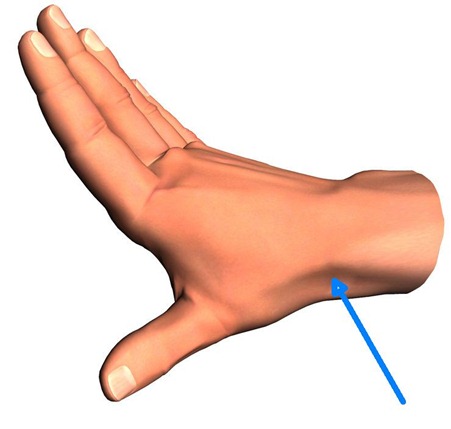
hand with arrow1
She pointed to where it hurt, which was the same on both left and right.  Uh, that’s not where carpal tunnel hurts.  It wasn’t where nursemaid’s wrist hurts, either, and that was what I had been thinking.  I touched where she said it hurt, and she confirmed a little bit of pain.  I asked her to hold her hand bent in a certain way, then I pressed her thumb across her palm.  This hurt a little, too.  In this position, I pressed on the spot pointed out by the arrow in the picture above.  She jumped.  This was the Finkelstein Test—I’m not making that up.  I know, it sounds like an algebra mid-term from high school.  (He published this in the late 19th-century, I think.)  Her reaction led me to her diagnosis.

DeQuervain’s Tenosynovitis isn’t something that people assume they have.  It occurs mostly in women, mostly in their 30’s and 40’s.  It is thought that long before Dr. DeQuervain stuck his name to it more than 100 years ago, it was known as mother’s wrist.

If a little knowledge is a dangerous thing, what about knowing about the Finkelstein Test?  I suppose it would be right to say I couldn’t be positive about her diagnosis, but I was pretty sure this is what she had. 

Here are some of the issues for me as a physician:
  1. I’m not a doctor for grown-ups.  Do I mind my own business even if I think I’ve got a clue—and maybe they don’t? 
  2. Do I say something cautious like, ‘Maybe you should get another opinion.’  Isn’t my opinion another opinion?
  3. If I say, ‘Have you looked into DeQuervain’s Tenosynovitis?  It’s going around,’ what is the message I’m really sending?
  4. If I say, ‘I believe you have DeQuervain’s Tenosynovitis,’ what is my next obligation?  Do I have to treat it or suggest treatment?
  5. What if I’m wrong?
  6. How much work do I have to do, especially since I can’t get paid for any of it?  Officially, the mother is not my patient.
  7. Since I was bold enough to bring up the fact that I can’t get paid anything for diagnosing or treating the mother, it’s obvious that this fact doesn’t reduce my potential liability.
So here, too, is a problem with medical specialization.  I presume that if the crippling pain were bad enough, this woman’s repeated visits to her primary care physician would eventually have led her to an orthopedic surgeon.  Hopefully they have already paid for their college-age child’s BMW (not that I’m cynical about it), and will not simply advise the woman to have hand surgery when a splint and some Advil is all she might need.  In the meantime, my patient—a sweet baby who needs to be held and nursed and changed and loved by his mother—will suffer. 

Let me go one step further.  If I know the diagnosis, if I can help this woman’s suffering, don’t I have some sort of obligation to help?  Am I required to look the other way because of my contract with her health-insurer?  In this case, of course, there isn’t anything life-threatening that would meet the criteria of what any reasonable person would do.   This comes up, for example, when somebody is obviously gravely hurt and anybody—not just a doctor—would call for help. 

Do you think I’ll leave it at that?  I didn’t think so.  This case is a proxy for treating even my own patients for mental health problems.  Though child mental health care (and to a lesser extent adult mental health, as well), is usually either completely unavailable or nearly unavailable; though it is unaffordable if available; and though access to it is severely limited by health insurance, physicians are generally precluded from providing this care.  So even though I’m willing to do it, I do a good job—especially with certain problems, I’m available and I’m willing to take about 20-30% of what they would usually have to pay, insurance companies will not pay me to diagnose and treat most mental-health problems.  Some won’t even let me prescribe the appropriate medications.  (I can prescribe them, but they won’t pay for them.)

And it’s a proxy for the inadequate recognition and treatment of postpartum depression.  This is seen by me, diagnosed by me, treated by me.  I get paid nothing for this, yet there’s no one to whom I can refer these women.  I’m lucky that one of the authorities in the field is nearby and will take referrals—without taking insurance.  After her, however, it’s me.

Just because I make no secret of believing I should be paid for my work doesn’t mean I won’t do what’s required of me.  By me.  So I had to create my own practice where the family of the baby got what it needed for the benefit of the baby.  That, in the big picture, is Holistic Medicine.

I found some information on DeQuervain’s Tenosynovitis on the internet and printed it out for her.  Treatment required a completely different kind of splint, which I also described.  I don’t know the name of her doctor and didn’t ask who it was.  But I deeply suspect that there were only a couple of reasons that she was still suffering in pain.  Either the doctor didn’t know about this unusual diagnosis, or didn’t listen carefully enough to the patient.  It was in her description of the the problem, the timing of its onset, and the exact location of the pain that eliminated diagnostic possibilities like carpal tunnel syndrome.  I think these are both potential problems:  a doctor who doesn’t know or a doctor who doesn’t listen.  Nobody can know everything, and this is an unrealistic goal.  But it would be great if doctors would spend the time to listen carefully, and then be open about not knowing.  When that happens, good doctors hit the books.

As a closing aside, this is an ongoing pattern in Every Patient Tells a Story, a book about unusual diagnoses that I like a lot and reviewed in this blog a while ago.  Though the author was kind about it, the first doctor to see these unusual problems often didn’t make a correct diagnosis.  But at some point, all the patients described finally saw a professional who wouldn’t give up, even if they didn’t know.  They reasoned it out, did what homework was needed, and got to the diagnosis.  Of course, they weren’t paid more for this extra work than the doctor who said, because it would take the least time, ‘carpal tunnel syndrome.’

Friday, July 30, 2010

Vaccine Refusal and Ethical Issues


All the families who bring their kids to see me know that, in general I’m a supporter of childhood vaccination. On balance, the risk to your child of a devastating or lethal disease with known and terrible effects seems to dominate the risk of vague eventual possibilities of problems that are either unproven or completely debunked. This post is not about why you should vaccinate your baby. Though you should.

I’m in a pretty privileged position. None of my patients comes to me just because my name was on the list from the insurance company. A parent picked me, researched me, got my name from a friend or coworker. Sometime, I’m gratified to say, they get my name from a nurse in Labor and Delivery or from one of the lactation consultants or midwives. Some of my most difficult cases come to me on the recommendation of my pediatric colleagues who have practices of their own.

So it’s what is generally called a self-selecting group. They are here because they want to be here. When parents expecting their first baby come to interview me, many don’t know my views on vaccination. Perhaps it’s a result of being located here in Berkeley, but I don't get parents who have heard that vaccines are harmful, and want to learn my professional opinion. I get those who say they want me to be their child's doctor because they have read or heard about me, but have made up their minds about vaccines. I wonder what they really want from me. If they don't want my medical expertise, they why are they coming to me? How can I help them? I hope that I will always provide the best care I can, but I was not trained in and do not know how to provide some reduced level of care.

What prompted this observation is a comment I read on one of the informational websites for physicians. A very smart academic doctor pointed out that when we treat families who refuse vaccinations, we are really being asked to provide substandard care. He argued that if we send these families elsewhere, we have lost the opportunity—perhaps many opportunities—to educate them and help them appreciate the value of this intervention.

It makes sense to engage with these parents. Most of them are extremely well-educated and literate. I would love to give them literature on the subject, cite references, tell them my own horror stories to counter the ones they heard from the internet, the parent group, or in the check-out line at the local organic market. I'd love to tell them that one of the local Montessori schools was closed twice in the last year by the Public Health Department for being a center of major pertussis epidemics. But I get the sense that they are not interested in receiving this information, or perhaps just not from me.

The parents of every child make essential health decisions every day. They manage the diet, activity, and safety of their children. Hopefully, they balance protection with freedom, and find a way to let the child ride a bicycle but still make them wear a helmet. I don’t think I’m the only one who is shocked when driving in a parking lot and a toddler is walking along without holding a grown-up’s hand, while they walk far behind, texting. That’s not OK! I keep my mouth shut when this happens, but I mutter unflattering things as long as my car’s windows and doors are closed.

But I am required, as much by my own standards as those of my state licensing board, to practice at very least at the standard of care. If the kid needs an antibiotic, I prescribe an antibiotic. For this reason, doctors shouldn’t be complacent with the nonvaccinating parents. It seems like a strategy of engagement is a reasonable way to go.

But I'm scared. In the past couple of weeks, I saw in my office a pair of former preemie twins. They are now about 6 and 8 pounds or so, and just got out of the intensive care unit. They are over 2 months old. Having unvaccinated kids in my office would seem to put them at substantial incremental risk. What is my responsibility to them?

That's not the only reason I have problems seeing unvaccinated kids in my practice. I feel so strongly about the importance of a meaningful doctor-patient relationship that I'm unclear about my role in their care. If I prescribe a medication to help your child breathe but you don't give it to your child, and instead use what your homeopath recommends, why did you consult me in the first place? If HIB vaccine could save your baby's life (or brain) but you refuse it, how much trust do you really have in me, my judgment, my training? It's better to bring your child to an advisor you really trust, whose expertise you respect, who can provide the care you really want and value.

I have absolutely accomplished one of the goals I set out for myself when I started this practice. I have patients and families that I know and who respect my guidance. This is probably a logical point at which to note that this doesn’t mean slavish obedience! I expect my own doctors to give me their very best professional advice, and in return I promise them—though this is unspoken—that I will take it seriously and do the best I can. I haven’t always followed what they suggested. Occasionally, I thought they were wrong, or didn’t understand all the aspects to my situation or complaint. Most often I just couldn’t do what they wanted. I couldn’t afford it, couldn’t spare the time, couldn’t make it work for me in some important way. But it has never been because I thought they were stupid, uninformed, or malicious. It wouldn’t say good things about me if I continued to go to a doctor like that.

So if I recommend that you let me painfully inject into your baby something you believe to be poisonous, toxic, or unproven, or if by recommending this your belief is confirmed that I am little more than a meretricious shill for the Big Pharma cabal, why would you want me to see your child?
 
Sometimes, when the prospective parents are interviewing me but before they storm out of the office, the reason comes out. I’m not really going to be their baby’s doctor. I’m the safety net for the naturopath, homeopath, or chiropractor who will really be managing the baby’s care. Then, if something goes wrong, they can bring the baby to me.

car seat
So the first ethical problem I have with treating families that don’t vaccinate is the fundamental nature of their request. They have asked me, with their full consent, to provide substandard care. When asked about this, a physician said that it was like the family refused to use a car seat for the baby. They ask the pediatrician, however earnestly, ‘What’s the best way to hold the baby while driving?’ Not only isn’t there a good way to hold the baby, but it would be unethical to do the research which could tell us if holding one way is 100 times more potential lethal than using a car seat but holding a different way is only 92 times more potentially lethal than using a car seat.

This is a line from a common translation of the Hippocratic Oath: I will prescribe regimens  for the good of my patients according to my ability and my judgment and never do harm to anyone. There isn’t much about doing less than my ability because the helpless baby has parents with...issues.

But the second ethical problem is obvious. Though it doesn’t come up in Hippocrates, it’s a central tenet in medical ethics. Autonomy. The patient has the right to make decisions about themselves and their treatments. With children, it’s generally understood that this means that the parents get this autonomy. When exactly this ends, by the way, is unclear. Legally, kids who are 18 acquire most of the medical rights of adults. This is confused, of course, if mom and dad are still paying for the health insurance. And, varying state by state, teenagers of a certain age can ask for and receive contraception or contraception counseling. Sometimes psychological services. Babies...not so much. Our society makes an implicit assumption that a baby’s parents have the best interest of the child at heart. Luckily and almost always, that’s true. The parents who choose not to vaccinate aren’t trying to hurt their baby, they are trying to protect it in the best way they know. Given this complete and unquestionable lack of malice, don’t they deserve the autonomy we all expect?

And one more thing. If a parent came to my office obviously intoxicated, I wouldn't let them drive home. Maybe I’d call a taxi, maybe I’d drive them home or call someone to pick them up. I would intervene in some way to protect them, their child, the community of unsuspecting and unwarned drivers on the road who all agree to follow some shared set of rules that protect them all. I don't know how to resolve this ethical dilemma between their autonomy and my responsibility. When they decide not to vaccinate, it's not like holding the baby without a car seat—it’s loosening the straps a little bit in every baby's car seat. What's my obligation to them?

So I think there’s a third ethical problem: my responsibility as a physician in the community, perhaps as a citizen. It would be wrong to cry out, ‘Fire!’ if there was none. But do I have an obligation to cry out if I see one?

Tuesday, January 19, 2010

The Ethics of Vaccination, Part 1


In the unstudied ethics of primary-care pediatrics, is the particularly dark and unexplored corner of vaccination.

As my readers know, I suspect that ethicists suffer from Perimortal Obsession and the natural desire to be quoted in the media commenting on the latest rara avis of medical dilemmas.  But this alone doesn’t explain why this topic is so carefully avoided.  As I’ve pointed out again and again, the common ethical problems encountered in primary-care medicine every day are apparently unattractive subjects for professional academic ethicists.

There are several important ethical issues that apply to childhood vaccination as we do it here in the United States.  Each of these is worthy of a symposium of its own, but I’ll just list these as they come to mind, and put them here on the internet for all to see.  Maybe an ethicist (who already has tenure) will dare to pick up the gauntlet.  In fact, this is just a prologue to an ethical issue associated with vaccination that only presented itself to me a few weeks ago.  The rest of this list has been smoldering for a long time.  I should note for the record that I believe childhood vaccination to be the greatest breakthrough in pediatric health ever made.  I discourage parents who choose not to vaccinate their children from joining my practice (that’s a big topic on its own!).  So these ethical issues assume a priori that the usual vaccinations we give are safe and effective.

The keystone ethical problem in pediatrics is doing something to somebody who is not giving their consent.  A lot of the general parenting problems I get asked about fall into this category as well.  Often parents will be unaware of their conflict between doing what they know is best for the child and doing what the child likes.  Broccoli vs.. ice cream.  Bedtime vs.. staying up.  This is one of the hardest parts of any good parent’s job.  But can we justify vaccination ethically on this basis?

What is the ethical obligation of the parents to other parents, to the community as a whole.  Even if we concede that parents sometimes have a sucky job and have to make decisions that hurt their baby because the baby will be better for it, should they hurt their baby in order to help some other baby?  This is just what herd immunity is all about.  At what point, ethically and epidemiologically, is there a breakeven between the suffering of one child and an abstract public health benefit?

Notwithstanding the vaccinations that are ‘required’ for school entry, what should the ethical guidelines be that determine how a parent chooses to waive these requirements.  Here in California, you don’t need to prove anything or claim anything.  Just that you sign the following statement: 
I hereby request exemption of the child, named in the front, from the immunization requirements for school/child care center entry because these immunizations are contrary to my beliefs. I understand that in case of an outbreak of any of these diseases, the child may be temporarily excluded from school for his/her protection.
It’s pretty shocking to me, honestly, that the serious consequence warned of in the statement is that your kid may be asked to stay home for a few days.  Considering the overwhelming statistical likelihood that any outbreak of one of these vaccine-preventable diseases probably started with an unvaccinated child, it’s curious and disappointing to know that the parent is being warned neither of the potential for harm their child represents to everybody else, nor of the potential for death or serious illness with life-long injuries that they have chosen for their own child.


I believe that physicians must give honest answers to patients.  That’s not an ethical problem.  But I am often asked if a baby really needs polio vaccine.  I give an honest answer:  it’s still around in certain parts of the world, but not here in the United States; it’s a really, really bad thing to get, and cause permanent disability; it seems to be preventable with the vaccine; a polio vaccine has been used for about 50 years, and the problems with it have been few.  But do they need to get the shot?   There’s plenty of cases of Japanese Encephalitis in the world, and there’s a vaccine for it.  But people get in in South Central to East Asia.  If you’re traveling to Borneo, it’s probably a good idea to get the vaccine.  But kids here probably don’t need it, so they aren't required to get it.  Polio is much less widespread in the world (thanks to vaccination) than Japanese Encephalitis, and there are no cases in North or South America.  If the parents take the child to certain parts of Africa or Central Asia, it’s probably important to be vaccinated.  Yet kids here are required to get 4 or 5 shots of it.

I get a lot of similar questions about Hepatitis B vaccine, which is often given within 1/2 hour of birth.  It’s spread, generally, by tainted blood products, sharing needles and syringes, and intimate contact.  So even a cautious parent would be right to suppose their child won’t be at risk until adolescence.  I don’t think this argument holds up, by the way, though it’s right as far as it goes.  What isn’t considered are the accidents, the hypodermic needle your happy 2-year-old brings over to you in the park to show you what she’s found, the thing your kid picked up that turned out to have some unidentified blood on it.

Is it ethical to give some vaccines in infancy just to take advantage of a time when the patient can put up the least resistance and won’t remember the assault?  Should we wait until they can willingly participate—though we know that almost none of them would?  Is it ethical to give an adult patient a medication that causes anterograde amnesia, then do something unpleasant to them?  They suffer just the same, but they don’t remember it afterward.  Is that the same as not suffering?  This is common practice, by the way for procedures like endoscopy (from either end).  Somehow not remembering the pain and choking during the procedure is considered equivalent to not having any pain.

There's a deep ethical inconsistency with this belief.  If the patient is not able to give consent (they have a serious developmental delay, they have brain damage or severe mental illness, for example)  would we allow a painful procedure without pain control measures?  I think and hope this would be considered barbaric and potentially license-losing for the physician.  In what functional way, exactly, is this hypothetical severely-impaired person different from a 12-month-old?  Maybe none of these hypothetical patients will remember the procedure.  Why is this not OK, yet doing pretty much the same thing on an adult who is drugged not to remember the procedure (same pain, same outcome) is a cottage industry?  I'm not questioning the benificence of the parent or medical guardian involved.  The difference, of course, is the adult's ability to be informed about the pain and the drug and the amnesia, and to consent to it.  (The fact that laypeople consent to such a procedure is no testimony for it.  Remember that virtually no insurance companies will pay for second opinions.  Besides, what incentive is there for the proceduralist to innovate new and less painful ways to practice?)

There’s a little bit of new research which suggests that babies may indeed remember the pain of vaccination.  Even if they don't, it's not a strong enough ethical argument to claim that the baby won't remember the pain of the shots. It's painful, they don't consent.


Perhaps it's a universal truth that so many issues eventually touch upon money.  It is a mystery to me why palliation is so often difficult for insurers.  Surely pain is something that binds us together as humans.  Is it ethical not to use devices or techniques which can make vaccination less painful?  These do exist, but they cost real money.  Given the thin margins on vaccines for most physicians, use of these products could make the doctor lose money on every shot.  Do they have an ethical obligation to pay for the privilege of giving vaccinations?  Do insurers have an ethical obligation (oxymoronic, I admit) to pay for things that reduce the pain of vaccination?  Or is that a lifestyle choice?  I think it's worth a post of its own.

Monday, November 16, 2009

The Very Generous Aunt

Nestles mother book 1 When a baby is born at the local hospital, the clerk in Labor and Delivery calls the pediatrician identified by the parents. The call I received one night about 3:00 AM was a little hard to understand. Granted, I had been awakened. But I asked the clerk for the patient’s name. ‘Oran…,‘ she said, then ‘Oranolantu…,‘ then ‘…bat…. “Do you mean Oranolantubaataar?“ I asked. Relieved, she told me I had a healthy big baby girl to come in and take a look at. I knew the family, and took care of the 4-year old son. I told her I’d be in later that morning. She politely told me that everyone in Labor and Delivery would really like me to come in now. I got dressed and went to the hospital, fearing the worst.

The Charge Nurse for L&D, who is the supervisor of all the nurses and operations of the department except for the obstetricians, and always one of the most experienced veteran professionals there, met me at the elevator, before I entered the ward. She said she’d never seen anything like it and didn’t know if it was OK and wanted me to evaluate this and write a note about it in the chart. She was afraid the hospital might get sued, and maybe a little afraid of losing her job. When I walked into the room, I was not prepared for what I saw.

The mother I knew was smiling happily in bed. Her labor had been relatively short with this second child, born about 2 hours earlier. She greeted me warmly in her broken English. I looked around. “Where’s the baby?” I asked her. She pointed to the chair next to her bed on which was a young woman. ‘Sister’ was her one word introduction. This woman was bare-breasted and nursing the newborn child.

I had never seen anything like it. I met with a group of the nurses, the charge nurse, and others.

The transition from unencumbered adult to parent is always unforeseeably and indescribably enormous. It seems that in recent years, the pressure on new parents has continued to build. The parenting shelf in the bookstore has become a whole section with many aisles. Perhaps it’s a good thing that you now can choose to learn what one author thinks you should have been expecting while you were expecting and another author claims to help you raise a child who is an over-achieving, healthy, gifted, socially adept, high IQ athlete who knows both how to control her temper and who goes to sleep without problems. (My approach to advising parents is almost always to ask the child to provide the right guidance. They usually know.)

Why has this proliferation of parenting advice taken place? The simple answer is that there’s a market for it. Publishers are aware of the demand and are in the business of meeting it. What’s behind this demand?
The desire to produce a text on childrearing isn’t new. Especially with the industrial revolution, the idea gradually took hold that maybe there was a ‘right’ way to raise kids.

Especially for the new parent, and the new mother in particular, these books can seem like an essential reference. There is a tendency for new parents and new mothers in particular to feel that the ‘success’ of nursing the baby, soothing the baby, even bathing the baby is a great burden that falls on them and them alone. If things aren’t going exactly right in the first days and weeks, it’s hard for new mothers not to see that as a personal failure. This is a major contributor to postpartum depression. But what has caused this crushing pressure? Is this part of Eve’s curse (Genesis 3:16)?

brosamer
I don’t think so. According to archeological evidence, and teenage caveman 1958according to countless cave-people movies, humans most likely never went through a phase of living in completely isolated family units. The idea, maybe born out of the settling of the American West, that there would be settlers who lived a hardscrabble life by themselves on a ranch the size of some European countries, is not one that has typically existed elsewhere in the world. Sure there are subsistence farms and always have been, but they are small and the families live close to other families.
And, finally I’m getting to the point, all the households are multigenerational. With marriage as teenagers, there would usually be grandmothers and even great-grandmothers living with the new mother. There would be sisters and aunts with their babies, too. And despite the considerable work all the women were required to do, some of the work of childcare and an enormous amount of cumulative experience and wisdom would be easily available and given.

Though it’s a good guess that midwives, people with special expertise in childbirth, have been around for a long time, Lactation Consultants are likely a newer breed. Within a multigenerational household, there would be lots of sources of advice about sore nipples and babies who don’t latch well. I suspect that postpartum depression has always been with us, but some of its pervasive contributors--isolation, the feeling that every need of the baby must be met by the mother, the sense of failure if the mother’s milk hasn’t come in by day 3 or 4--would be so very much relieved by having a crew of experienced and trusted peers who know what the heck they are doing.

The baby’s mother was from one of the Mongolian families I take care of. Some speak no English at all. But they all live very near each other in one neighborhood of Oakland. Many bring their kids to me. Her sister had given birth a few months earlier, and was still nursing her own infant. In their culture, this wasn’t unusual--it was simply what was done.

About a hundred years ago, and for millennia before that, wet nurses were common. Women who couldn’t nurse or those who could but had the resources to avoid this task of the masses, would employ a woman whose lactation was maintained by her continued employment. There were few alternatives. (The picture above is from a booklet produced about 1900 by Nestle, for a product called Nestlé's Food, which was among the very first commercial baby formulas. It’s from my collection.) But before there were professional wet nurses, there were women who would share their supply with the less fortunate, or the babies who had survived childbirth when their mothers did not.

One of the nurses asked if it was hygienic. Honestly, I didn’t know. I suppose, in these days of Universal Precautions and doctors afraid to touch you without gloves on, I could see what the concerns might be. There are some diseases which can be transmitted through breast milk, along with many medications. As politely as I could, I tried to get a little medical history from this other woman. She spoke almost no English, and the postpartum mother was translating my questions—I think. She’s the one who told me ‘she OK’ and left it at that.

I told the L&D crew it was OK with me and I would write an order in the chart explicitly allowing it.


The woodcut from 1550 is by Hans Brosamer and is from my collection. It shows the creation of Eve, her temptation, and the expulsion from the Garden of Eden. The poster from the 1958 movie Teenage Caveman was part of the collection I sold in 1992. Produced by—who else?—Roger Corman, I think it was Robert Vaughn’s first starring role.

Tuesday, August 4, 2009

The Generous Aunt

Nestles mother book 1 When a baby is born at the local hospital, the clerk in Labor and Delivery calls the pediatrician identified by the parents. The call I received one night about 3:00 AM was a little hard to understand. Granted, I had been awakened. But I asked the clerk for the patient’s name. ‘Oran…,‘ she said, then ‘Oranolantu…,‘ then ‘…bat…. “Do you mean Oranolantubaataar?“ I asked. Relieved, she told me I had a healthy big baby girl to come in and take a look at. I knew the family, and took care of the 4-year old son. I told her I’d be in later that morning. She politely told me that everyone in Labor and Delivery would really like me to come in now. I got dressed and went to the hospital, fearing the worst.
The Charge Nurse for L&D, who is the supervisor of all the nurses and operations of the department except for the obstetricians, and always one of the most experienced veteran professionals there, met me at the elevator, before I entered the ward. She said she’d never seen anything like it and didn’t know if it was OK and wanted me to evaluate this and write a note about it in the chart. She was afraid the hospital might get sued, and maybe a little afraid of losing her job. When I walked into the room, I was not prepared for what I saw.
The mother I knew was smiling happily in bed. Her labor had been relatively short with this second child, born about 2 hours earlier. She greeted me warmly in her broken English. I looked around. “Where’s the baby?” I asked her. She pointed to the chair next to her bed on which was a young woman. ‘Sister’ was her one word introduction. This woman was bare-breasted and nursing the newborn child.
I had never seen anything like it. I met with a group of the nurses, the charge nurse, and others.
The transition from unencumbered adult to parent is always unforeseeably and indescribably enormous. It seems that in recent years, the pressure on new parents has continued to build. The parenting shelf in the bookstore has become a whole section with many aisles. Perhaps it’s a good thing that you now can choose to learn what one author thinks you should have been expecting while you were expecting and another author claims to help you raise a child who is an over-achieving, healthy, gifted, socially adept, high IQ athlete who knows both how to control her temper and who goes to sleep without problems. (My approach to advising parents is almost always to ask the child to provide the right guidance. They usually know.)
Why has this proliferation of parenting advice taken place? The simple answer is that there’s a market for it. Publishers are aware of the demand and are in the business of meeting it. What’s behind this demand?
The desire to produce a text on childrearing isn’t new. Especially with the industrial revolution, the idea gradually took hold that maybe there was a ‘right’ way to raise kids.
Especially for the new parent, and the new mother in particular, these books can seem like an essential reference. There is a tendency for new parents and new mothers in particular to feel that the ‘success’ of nursing the baby, soothing the baby, even bathing the baby is a great burden that falls on them and them alone. If things aren’t going exactly right in the first days and weeks, it’s hard for new mothers not to see that as a personal failure. This is a major contributor to postpartum depression. But what has caused this crushing pressure? Is this part of Eve’s curse (Genesis 3:16)?
brosamer
I don’t think so. According to archeological evidence, and teenage caveman 1958according to countless cave-people movies, humans most likely never went through a phase of living in completely isolated family units. The idea, maybe born out of the settling of the American West, that there would be settlers who lived a hardscrabble life by themselves on a ranch the size of some European countries, is not one that has typically existed elsewhere in the world. Sure there are subsistence farms and always have been, but they are small and the families live close to other families.
And, finally I’m getting to the point, all the households are multigenerational. With marriage as teenagers, there would usually be grandmothers and even great-grandmothers living with the new mother. There would be sisters and aunts with their babies, too. And despite the considerable work all the women were required to do, some of the work of childcare and an enormous amount of cumulative experience and wisdom would be easily available and given.
Though it’s a good guess that midwives, people with special expertise in childbirth, have been around for a long time, Lactation Consultants are likely a newer breed. Within a multigenerational household, there would be lots of sources of advice about sore nipples and babies who don’t latch well. I suspect that postpartum depression has always been with us, but some of its pervasive contributors--isolation, the feeling that every need of the baby must be met by the mother, the sense of failure if the mother’s milk hasn’t come in by day 3 or 4--would be so very much relieved by having a crew of experienced and trusted peers who know what the heck they are doing.
The baby’s mother was from one of the Mongolian families I take care of. Some speak no English at all. But they all live very near each other in one neighborhood of Oakland. Many bring their kids to me. Her sister had given birth a few months earlier, and was still nursing her own infant. In their culture, this wasn’t unusual--it was simply what was done.
About a hundred years ago, and for millennia before that, wet nurses were common. Women who couldn’t nurse or those who could but had the resources to avoid this task of the masses, would employ a woman whose lactation was maintained by her continued employment. There were few alternatives. (The picture above is from a booklet produced about 1900 by Nestle, for a product called Nestlé's Food, which was among the very first commercial baby formulas. It’s from my collection.) But before there were professional wet nurses, there were women who would share their supply with the less fortunate, or the babies who had survived childbirth when their mothers did not.
One of the nurses asked if it was hygienic. Honestly, I didn’t know. I suppose, in these days of Universal Precautions and doctors afraid to touch you without gloves on, I could see what the concerns might be. There are some diseases which can be transmitted through breast milk, along with many medications. As politely as I could, I tried to get a little medical history from this other woman. She spoke almost no English, and the postpartum mother was translating my questions—I think. She’s the one who told me ‘she OK’ and left it at that.
I told the L&D crew it was OK with me and I would write an order in the chart explicitly allowing it.
The woodcut from 1550 is by Hans Brosamer and is from my collection. It shows the creation of Eve, her temptation, and the expulsion from the Garden of Eden. The poster from the 1958 movie Teenage Caveman was part of the collection I sold in 1992. Produced by—who else?—Roger Corman, I think it was Robert Vaughn’s first starring role.

Saturday, April 18, 2009

The Bridgeport Paradox: Black and White in the Delivery Room


Connecticut is one of the richest states in the United States. Most of its many wealthy people live on the 'Gold Coast' which is within commuting distance to New York City and is along the shore of Long Island Sound. The richest county in Connecticut is Fairfield county, where low-density communities are filled with some of the most expensive private homes in America.

There are no major hospitals in these affluent towns, owing to their low population density. So when the rich and famous need a hospital, they go to the nearest major medical center, Bridgeport Hospital.


Bridgeport is an island of poverty in this sea of wealth. A booming 19th-century industrial town, it gradually ran out of most manufacturing jobs decades ago. It has double the state's average rate of people living in poverty, and triple the rate of the poorest poor—people living at less than 50% of the poverty rate.

When I did my required training rotation through Obstetrics, I was assigned to Bridgeport Hospital. It's a big urban medical center, with a busy Labor & Delivery ward. Almost all of the Obstetricians in the area had luxurious private offices located in the adjoining wealthy communities, where they served an exclusive clientèle, mostly white. For deliveries, however, even the fancy doctors used the great facilities at Bridgeport (in private rooms). Some of these doctors in private practice, along with the doctors on staff at the hospital, also worked with the patients from Bridgeport, mostly women of color. Most of these patients didn't have private insurance, and sometimes didn't have insurance at all. These patients often had less prenatal care, and less access to medical care in general for any of their other medical needs. Many had complex social issues associated with poverty which complicated their care.

In this context, I expected that the wealthy, private-paying patients with their private physicians would somehow get better treatment and have an easier time. For many types of medical problems, this seems generally to be the case, and I expected it at Bridgeport Hospital, where the stark contrasts in patient resources are dramatic.

The experience of my first day has remained deeply etched in my memory. I was told to wait at the nurse's station of the obstetrics ward. The screaming started within minutes of my arrival. It was the most disturbing sound I had ever heard. Clearly screaming in severe pain, the halls were filled with this sound which came from behind a closed door. I was new there, but I asked the nurse sitting next to me, who was browsing through a catalog for scrubs with cartoon characters, if we should go in there and help. She was very kind and explained that the obstetrician was already in the room and the woman had said that she didn't want any interference or medication. Within a couple of hours of this, a new patient was wheeled in to another private delivery room. With her was her husband, her doctor, and her personal secretary. After getting settled, the personal secretary left the room and sat in the waiting area. A second source of intense and disturbing screaming started coming from this room, too. Now there were two.

Before lunch, an ambulance brought in one of the local women, and the nurse sitting next to me dropped her catalog (by now she had moved on to a shoe catalog), and prodded me to come along. I didn't do anything at my first delivery, but I watched a very skilled doctor give this woman an epidural anesthetic. A couple of hours went by before she had her baby, which is about the most fabulous thing a person could witness. She pushed and was awake and happy when the delivery nurse put her new baby into her arms.

I don't know what happened in those private rooms, as I was never invited in. But this experience was repeated nearly every day I was there. I asked one of the obstetricians about it. She told me that many of her private patients refused all medications and wanted what she called the 'full experience' of childbirth and motherhood. She said this wasn't often the case with the inner-city mothers she treated in the hospital. She never really thought about it, and tried to give her patients what they requested.

So much suffering, both medical and otherwise, falls heaviest on the poor. What I witnessed was counter-intuitive: the rich were enduring unspeakable pain, and the poor were not. I'm not an obstetrician, but I do look upon my job as trying to ease suffering if I can. Were the poor women getting better advice than money could buy? Maybe they just had more common sense.